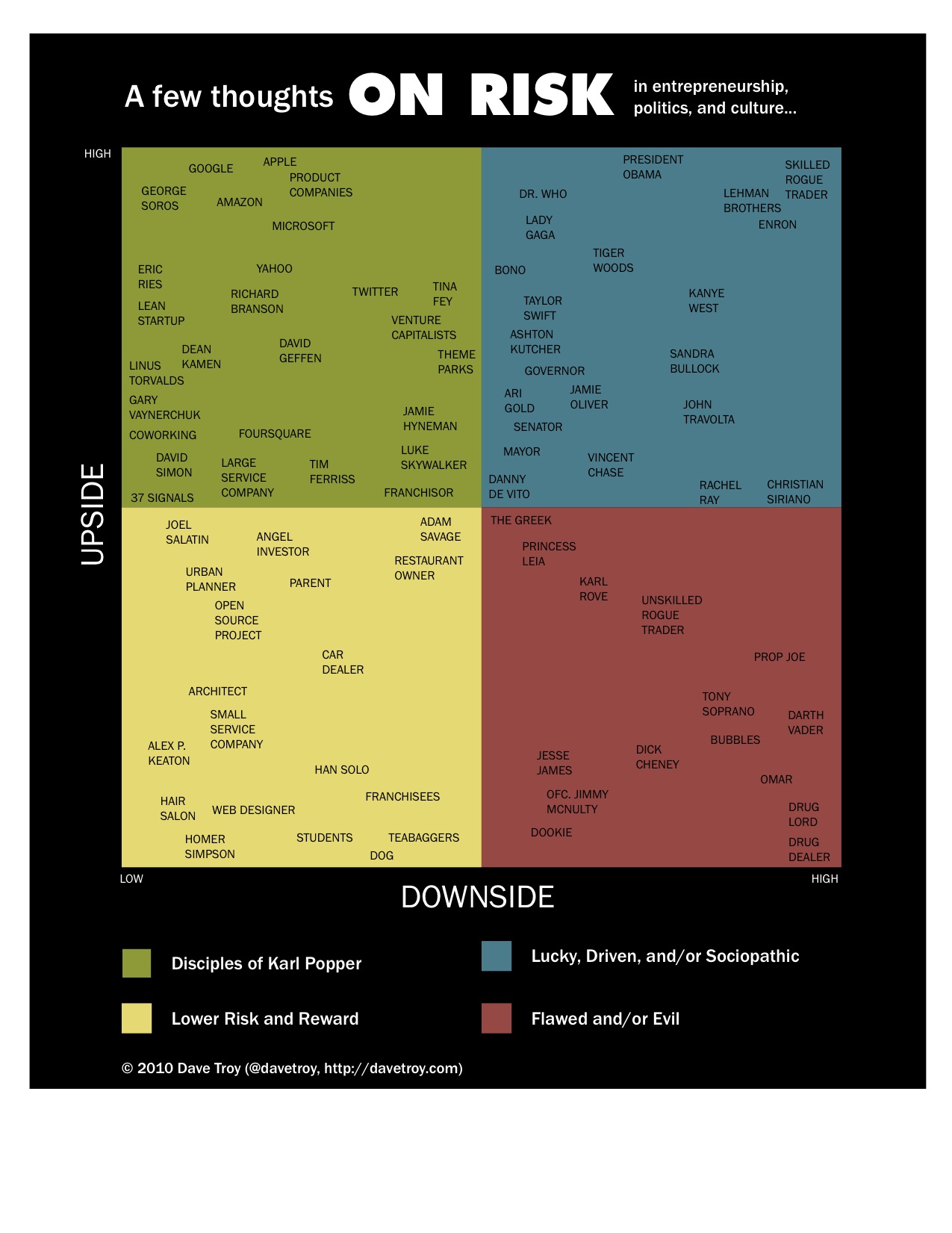
You’re welcome. Discuss.
On Risk
April 1st, 2010 — business, design, economics, philosophy, politics, software, trends, visualization
Public Life Without Politics
January 9th, 2010 — baltimore, business, design, economics, geography, philosophy, politics, trends
This week saw the ending of a tragic saga that has been decades in the making. Baltimore Mayor Sheila Dixon negotiated a plea agreement to obtain Probation Before Judgment in which she promised to resign as mayor within 30 days. She entered an Alford plea, in which she did not admit guilt but admitted that the prosecution had sufficient evidence to convict her.
But the real story here isn’t about Dixon; it is about the long-term systemic abandonment of public life by the American citizenry.
And I use that term loosely. Americans take a cynical eye towards civics and citizenship. Public servants are routinely portrayed as buffoons and as half-witted wards of the state. Politicians are universally derided as corrupt, megalomaniacal, and intensely self-interested. Depending on the election, Americans vote in anemic numbers. Children are no longer seriously raised with the idea that civic engagement or public service is a kind of higher calling.
We are now consumers of politics rather than participants in civic life. And the accompanying “fanboyism” that we see in consumer behavior has effectively destroyed intelligent political discourse. Presumably somewhere out there there is a sticker of Calvin Elephant pissing on a Democrat Donkey. Enough.
The Dilemma of the American City
A confluence of factors over the last 90 years has drawn people from the urban core to the suburbs: air quality, the invention of the automobile, the Great Depression, unchecked suburban planning, school policy, racial prejudice and realignment, blockbusting profiteers, the end of urban manufacturing, ineffective urban planning, drug use, tax imbalances, poor transportation infrastructure, and incompetent city governments.
This has resulted in cities that have neither the tax base nor the level of civic engagement required to operate. The politicians do not have the skill or vision to initiate meaningful change. The population wants improvement and change but is often unwilling to exchange their short term interest for any long-term good. Surrounding jurisdictions point fingers at the city, and the problems become self-reinforcing. For each day that our cities slog on in dysfunction, the more people are convinced that dysfunction is a permanent and intractable condition.
To change things in the long term, we need to attract people back into our cities. And there are workable strategic reasons why this is possible: cities provide real competitive advantage, particularly for industries based on ideas and information.
Urban Feudalism
It is not a coincidence that the graft case against Dixon was centered around her relationship with multiple developers. This 2008 City Paper article gives a good sense of the shadowy web of relationships surrounding the Mayor, her predecessor, and developers.
It requires a special kind of optimism to think that the gift cards, cash, and other baubles that Dixon received were anything other than bribes. While it is laudable to offer her the benefit of the doubt, the reality is that she did receive these gifts from developers. And developers have more impact on the design and function of our city than any other single business constituency.
While we can defend Dixon’s sincere love for her city, her ambitious agenda, her mostly-functional administration, and her political bravery, the tragic truth is that she fell victim to the inherent flaws of the very place that made her. The culture of personal gain over civic duty is pervasive and inescapable in Baltimore. And the government accurately reflects the values of its people.
Our cities plod along, hostage to the special interests and powerful “players” to whom we have consigned our urban future. We have enabled and continue to refine a new system of urban feudalism, its landscape populated by warlords each concerned with their own particular brand of self-interest. There is precious little difference between a corner drug dealer and the Mayor of Baltimore when everybody’s on the take.
A Path to Recovery
It is easy to complain about American public life and politics, and real solutions are hard to find. James Fallows argues in this Atlantic Monthly article that while the American system of government has been horribly hamstrung by special interests, the only hope we have is continued engagement. He argues that we cannot divorce public life and the private sector, as both fail when that happens.
I believe there may be yet another pathway forward, inspired by the great American thinker and architect Buckminster Fuller’s quote: “You never change things by changing the existing reality. Instead, build a new model that makes the existing reality obsolete.” If there is a way forward it is in this direction.
Public Life Without Politics
We have become accustomed to the idea that participation in public life comes only in the form of elected office or through lumbering nonprofit organizations. But there is an emergent form of public engagement centered around alignment behind ideas. The Internet has enabled likeminded people to converge both online and in the real world to achieve amazing goals, all without the burdens of machine politics and the slow-moving governance of nonprofits.
American cities offer an exceptionally strong opportunity for our country to return to competitiveness on the world stage. Compact, efficient, and diverse, our cities are platforms upon which we can design an economic life predicated on two key core values: respect for place, and respect for people and their time.
If we truly love our place and our people, competitive advantage will flow naturally from there. Embracing our cities is a pro-business agenda. It’s a future where everyone wins.
An Apolitical Future
Until recently, the flow of information to citizens has been imperfect and incomplete, and political parties have acted as proxies to enable people with similar values to coalesce.
But as information flow becomes more perfect and attitudinal alignment can occur in higher-resolution ways, political parties may no longer be effective channels for achieving important public goals.
To the extent that people can rally around goals and achieve real results using apolitical modern organizing efforts, we may find that the future of public life lies in individual action rather than in elected office or in nonprofit organizations.
Our country’s future demands that we find the answer.
20th Century, Go to Sleep
November 5th, 2008 — economics, politics, trends
I may not exactly be what you’d call a futurist, but I do spend a lot of time thinking about the future and the evolution of ideas.
Since 2001, our country has been a breathing anachronism — a zombie-corpse of outdated ideology and backward-looking worldviews — living in a state of Cold War suspended animation, pushing outdated agendas and peddling simplistic platitudes to an indifferent world which had increasingly moved on to other things and the urgent business of reality.
Yesterday, we said “enough” to sticking our heads in the sand. Yesterday, we said “no” to “drill baby drill,” and “yes” to a real and sustainable energy economy. And yesterday, we showed the world that the America that they love — the America that its founders had hoped it would become — is back, functioning and healthy.
I’m not naïve enough to think that one political party or another will magically take the country in the right direction. In fact, now is when the real work of shaping policy through direct political action will need to begin. The battle is not over now. You must participate to get the kind of country you want to live in, and that’s true regardless of who is in office.
But, one thing is true: leadership matters. And at this time of transition and change, America desperately needed a leader with imagination, hope, and a sense of the future. And we have that leader in Barack Obama. He has singlehandedly rewritten the rules of presidential politics in America and has proven that he is the political heir of both Kennedy and Reagan. Barack Obama has brought hope back to America and the world. With Barack Obama, the 21st century begins in earnest.
As children, we were all sold a vision of the future, and this was supposed to be it. We were supposed to be rocketing around with jetpacks, with robot assistants and TV watches. By the year 2000, children imagined their lives would be studded with space age marvels. But, 2000-2008 has felt more like the final cold grasp of a 20th century that has outlived its welcome; a sick and disordered hallucination of the century that wouldn’t die.
I remain a student of history, and I am thoroughly ready for the 20th Century to pass into the history books, and now, packed up and archived along with the last 8 years which are rightfully its, I send it on and bid it farewell. 20th Century, go to sleep; really deep; we won’t blink.
2009 is the new 2001. Welcome to the future.
Twittervision Election View
September 26th, 2008 — art, design, economics, politics, programming, rails, ruby, social media, software, trends, visualization
An hour or so ago I launched Twittervision Election View, allowing viewers to see posts to Twitter about the 2008 election in their original geographic context.
Twitter launched something similar this morning, and the idea to do a political view of Twittervision has been around for a while, so it seemed natural to try to do this now and especially in advance of tonight’s debate.
We have some enhancements planned, and right now the site is getting a ton of traffic as people discover it… we should be able to put some more server capacity on it which should keep things steady.
Let me know what you think!