May 16th, 2010 — baltimore, business, design, economics, geography, philosophy, politics, trends
The American educational system deadens the soul and fuels suburban sprawl. It is designed as a linear progression, which means most people’s experience runs something like this:
- Proceed through grades K-12; which is mostly boring and a waste of time.
- Attend four years of college; optionally attend graduate/law/med school.
- Get a job; live in the city; party.
- Marry someone you met in college or at your job.
- Have a kid; promptly freak out about safety and schools.
- Move to a soulless place in the suburbs; send your kids to a shitty public school.
- Live a life of quiet desperation, commuting at least 45 minutes/day to a job you hate, in expectation of advancement.
- Retire; dispose of any remaining savings.
- Die — expensively.
Hate to put it so starkly, but this is what we’ve got going on, and it’s time we address it head-on.
This pattern, which if you are honest with yourself, you will recognize as entirely accurate, is a byproduct of the design of our educational system.
The unrelenting message is, “If you don’t go to college, you won’t be successful.” Sometimes this is offered as the empirical argument, “College graduates earn more.” Check out this bogus piece of propaganda:
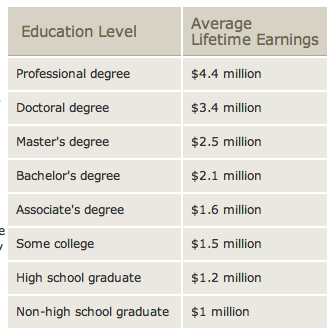
But what if those earnings are not caused by being a college graduate, but are merely a symptom of being the sort of person (socioeconomically speaking) who went to college? People who come from successful socioeconomic backgrounds are simply more likely to earn more in life than those who do not.
There’s no doubt that everyone is different; not everyone is suited for the same kind of work — thankfully. But western society has perverted that simple beautiful fact — and the questions it prompts about college education — into “Not everyone is cut out for college,” as though college was the pinnacle of achievement, and everybody else has to work on Diesel engines or be a blacksmith. Because mechanics and artists are valuable too.
That line of thinking is the most cynical, evil load of horse-shit to ever fall out of our educational system. Real-life learning is not linear. It can be cyclical and progressive and it takes side-trips, U-turns, mistakes, and apprenticeships to experience everything our humanity offers us.
The notion that a college education is a safety net that people must have in order to avoid a life of destitution, that “it makes it more likely that you will always have a job” is also utterly cynical, and uses fear to scare people into not relying on themselves. Young people should be confident and self-reliant, not told that they will fail.
And for far too many students, college is actually spent doing work that should have been done in high school — remedial math and writing. So, the dire warnings about the need for college actually become self-fulfilling: Johnny and Daniqua truly can’t get a job if they can’t read and write and do math. See? You need college.
An Education Thought Experiment
I do not pretend to have “solutions” for all that ails our educational system. But as a design thinker, I do believe that if our current educational system produces the pattern of living I noted above, then a different educational system could produce very different patterns of living — ones which are more likely to lead to individual happiness and self-actualization.
If we had an educational system based on apprenticeship, then more people could learn skills and ideas from actual practitioners in the real world. If we gave educational credit to people who start businesses or non-profit organizations, and connected them to mentors who could help them make those businesses successful, then we would spread real-world knowledge about how to affect the world through entrepreneurship.
If more people were comfortable with entrepreneurship, then they would be more apt to find market opportunities, which can effect social change and generate wealth. If education was more about empowering people with ideas and best practices, instead of giving them the paper credentials needed to appear qualified for a particular job, it would celebrate sharing ideas, rather than minimizing the effort required to get the degree. (My least favorite question: “Will that be on the test?”)
Ideally, the whole idea of “the degree” should fade into the background. Self-actualized people are defined by their accomplishments. A degree should be nothing more than an indication that you have earned a certain number credits in a particular area of study.
If the educational system were to be re-made along these lines, the whole focus on “job” as the endgame would shift.
“A sturdy lad from New Hampshire or Vermont, who in turn tries all the professions, who teams it, farms it, peddles, keeps a school, preaches, edits a newspaper, goes to Congress, buys a township, and so forth, in successive years, and always, like a cat, falls on his feet, is worth a hundred of these city dolls. He walks abreast with his days, and feels no shame in not ‘studying a profession,’ for he does not postpone his life, but lives already. He has not one chance, but a hundred chances.” — Ralph Waldo Emerson, Self Reliance, 1841
And so if the focus comes to be on living, as Emerson suggested it should be, and not simply on obtaining the job (on the back of the dubious credential of the degree), then the single family home in the suburb becomes unworkable, for the mortgage and the routine of the car commute go hand-in-hand with the job. They are isolating and brittle, and do not offer the self-actualized entrepreneur the opportunity to meet people, try new ideas, and affect the world around them.
The job holder becomes accustomed to the idea that the world is static and cannot be changed through their own action; their stance is reactive. The city is broken, therefore I will live in the suburbs. The property taxes in the suburbs are lower, so I will choose the less expensive option.
Entrepreneurial people believe the world is plastic and can be changed — creating wealth in the process. But our current system does not produce entrepreneurial people.
Break Out of What’s “Normal”
It may be a while before we can develop new educational systems that produce new kinds of life patterns.
But you can break out now. You’ve had that power all along. I’m not suggesting you drop out.
But I will say this: in my own case, I grew up in the suburbs, went to an expensive suburban private high-school — which I hated — where I got good grades and was voted most likely to succeed.
I started a retail computer store and mail order company in eleventh grade. I went to Johns Hopkins at 17, while still operating my retail business. Again, I did well in classes, but had to struggle to succeed. And no one in the entire Hopkins universe could make sense of my entrepreneurial aspirations. It was an aberration.
I dropped out of college as a sophomore, focused on my business, pivoted to become an Internet service provider in 1995, and managed to attend enough night liberal arts classes at Hopkins to graduate with a liberal arts degree in 1996. This shut my parents up and checked off a box.
I also learned a lot. About science. About math. About philosophy, literature, and art. And I cherish that knowledge to this day.
But I ask: why did it have to be so painful and waste so much of my time? Why was there no way to incorporate that kind of learning into my development as an entrepreneur? Why was there no way to combine classical learning with an entrepreneurial worldview?
Because university culture is not entrepreneurial. And I’m sorry, universities can talk about entrepreneurship and changing the world all they like, but it is incoherent to have a tenured professor teaching someone about entrepreneurship. Sorry, just doesn’t add up for me. Dress it up in a rabbit suit and make it part of any kind of MBA program you like; it’s a farce. Entrepreneurship education is experiential.
I had kids in my mid-twenties and now have moved from the suburbs to the city because it’s bike-able and time efficient. And I want to show my kids, now ten and twelve, that change is possible in cities. I believe deeply in the competitive advantage our cities provide, and I intend, with your help, to make Baltimore a shining example of that advantage.
I don’t suggest that I did everything right or recommend you do the same things. But I did choose to break out of the pattern. And you can too.
Maybe if enough people do, we can build the new educational approaches that we most certainly need in the 21st century. This world requires that we unlock all available genius.
May 15th, 2010 — baltimore, business, design, economics, software, Uncategorized
The recent discussions of entrepreneurship here prompted several entrepreneurs to contact me, both via email and in person. Here is one kindred-spirit’s story, reproduced (and edited) with permission.
Hey Dave,
I’ve been reading your blog for the last week or so, and I wanted to let you know I appreciate your thoughtful angle on entrepreneurship, design, and intellectual life. Like many of your posts indicate, the challenges of developing personal creativity and starting something new are profound in our current culture. Last June I graduated with an engineering degree from the University of Maryland. Instead of acting on ideas to change the world, I did, as most graduates do these days, took the full time job that paid the most. (Chris Dixon’s post on the topic hits it). Add consulting and government consulting to where all the talent goes in the DMV. To a college kid, the prospects of a $70,000 salary are blinding. And if you consider yourself a self-starter, you realize quickly that you are fighting a powerful majority that would call you crazy for not taking such a lucrative offer.
That said, I have devoted a lot of my free time to developing my startup ideas through mockups and requirements. Yet, despite my engineering background, I just don’t see myself as the technical co-founder that many think is the necessary half of successful startup teams. I can spend hours reworking code, but developing from scratch is beyond me. So the question I have been struggling with is how do I find the real technical partner? As you posted, startups are about the people, but finding that passionate partner is incredibly difficult.
My current idea that I have been toying with revolves around [redacted]. From mobile app, to website … I am at a point where I would consider outsourcing app development, just because I believe in my idea and want to make progress. However, say a couple months into the future, I now have an iPhone App (and a lot less money) but I still don’t have a team to further the idea. In addition, I am not so sure my concept has clear profitability, but at my age (23) what’s wrong with idealism as a starting point?
Sorry for the length, but I wanted to offer some of my thoughts as to what it means to be on the outside of entrepreneurship, wanting in. Any return advice would be great!
Regards,
Lance
My response to Lance:
Lance,
Thanks for writing! Certainly sounds like you have the right spirit about things, and I agree with you re: Chris Dixon’s post. He’s got a very good take on things.
Some things I’d recommend:
1. Subscribe to Startup Digest Baltimore. Go to http://thestartupdigest.com
2. Go to Innovate Baltimore on Wednesday 5/19 and introduce yourself. http://innovatebaltimore.com
3. Come hang out at Beehive Baltimore. It’s where the community is centered. http://beehivebaltimore.org
4. Let’s find a time to talk some more. I am out of town for two weeks starting next Friday but we can find a time in June. Pick something: http://tungle.me/davetroy
Looking forward to meeting you!
Do you mind if I share your note, along with my response, on my blog?
I want to keep reminding people that there are LOTS of people like you out there…
Best,
Dave
Response from Lance:
Sure. No problem. If you could edit out the sentence or two about my current idea, that would be great. Also, I currently live in the Northern Virginia area, so I’ve been on the DC and Baltimore Startup since I was introduced to them at BootstrapMD. I just started looking for resources like InnovateBaltimore and BeehiveBaltimore around DC. Any suggestions?
Thanks,
Lance
My response to Lance:
OK, thanks.
You should consider moving to Baltimore as the startup + coworking scene is now a lot more active. Innovate and Beehive are just the tip of the iceberg.
There are some OK things going on in the DC area (Founders Institute, Launchbox Digital, Social Matchbox, DC Week), they run on weird schedules and are not active all the time. Baltimore’s scene is a lot more persistent and becoming much more interesting. Affinity Lab is like an expensive corporate version of coworking. Beehive is real coworking.
Anyway, I’m biased, but this is something we’re serious about in Baltimore and we’re committed to making it happen, all the way from the Governor to the Mayor to each individual startup.
Hope to see you around the Hive soon.
Best,
Dave
Why is being an entrepreneur considered so unusual in our university culture? I have a theory.
Bill Gates: dropout. Paul Allen: dropout. Steve Ballmer: dropout. Richard Branson: dropout. Warren Buffett: dropout. See a pattern?
Entrepreneurship is the opposite of University culture, which celebrates progressive levels of achievement, with the ultimate goal of becoming a college professor. Entrepreneurs create the circumstances of their own success, by changing the world around them and making their own game.
I’m not suggesting anyone dropout, but we do have to ask: is our educational system creating maximum value for society? Or is it just creating clones, steeped in the idea that there is only one true path to security and achievement, which are then manipulated by true entrepreneurs and leaders who really know how to shape the world around them? And which are you?
May 13th, 2010 — business, design, economics
I’ve been meditating on these two ideas, and they resonate for me. See what you think of them.
The Building
Imagine taking the roof off of your building and shaking out all of the people inside.
Now, rearrange the people into an optimal value-producing configuration.
I would bet that you could find a handful of combinations that unlock $1 billion in value; I’d bet you could find a few that unlock $10+ million in value; and I’d bet that 50% of the available combinations would unlock more value than the existing configuration.
What are the barriers that keep us from unlocking maximum value in our workforce? Walls, lack of connections, non-optimal application of resources, and addiction to personal cash-flow spring to mind.
Why do we perpetuate these non-optimal configurations of resources? What are you doing to unlock the potential in your building and in your broader community?
Keep the Same Team?
The more exposure I have to the world of startup investing (and to startups themselves) the more convinced I am that team is everything. At first I was more apt to evaluate a startup by its idea and its market metrics. But I’ve come to believe that all bets are bets on people.
In support of this strategy, I’ve started to look for heuristics that indicate that a particular team is worth betting on. And one question I am asking founders is this: If you do secure funding, would you keep the same people or would you hire new team members?
The answer can be revealing. If they indicate that they will keep the same team members, it’s worth asking why. And understanding the why behind the why. If there are good reasons why the team is well-cast, then this is likely a bankable team. Good reasons include expertise and real dedication. Bad reasons may include “knew them at my last job,” “he built it under contract,” or “found him at a meetup.”
There’s no hard and fast rule here, but the key thing to remember is that money changes everything. But if it changes too much of your team make-up, it’s probably not a bankable configuration to begin with.
How are you rearranging the world around you to produce optimal, bankable teams? To me, this is the essence of entrepreneurship. What do you think?
May 11th, 2010 — baltimore, business, design, economics, philosophy, software, trends
This post started out as a reaction to yesterday’s post by Matt Mireles in New York City about the dearth of talent available to startups there. I felt it was relevant to the Baltimore/Washington area and shared it with some of our local leaders. It sparked a deep conversation — which I captured below.
Dave Troy to some area investors, entrepreneurs, and economic development officials:
This blog post out of NYC is a decent analysis of the problems that east-coast tech startups face.
- Drop in “federal sector” in place of “Wall Street” and you have an almost perfect analysis of our situation here in Maryland.
- Scarce technical talent wants to be employees, not co-founders for equity.
- A large well-funded ecosystem that sucks up available talent (Wall St, Feds, etc)
- Universities are barely aware of the startup ecosystem and do not contribute a good supply of talent
As the guy points out, a few good exits and some Stanford-like thinking can quickly change things. Tomorrow he’s writing some about how the NYC community is addressing this problem.
Roger London (investor, director of America’s Security Challenge):
I agree for the most part. I would tweak it as follows (comments embedded below).
1. Scarce technical talent wants to be employees, not co-founders for equity.
Totally agree, however technical talent in this region is not nearly as sophisticated and picky as the Palo Alto engineer sited in the blog. While most technical talent here would not take equity or options in lieu of a paycheck, I believe there are many that could find a suitable combination. This crop of “vested” technologists will anchor our next generation of technology entrepreneurs. They must first get a taste for the long-term value of equity and just as importantly realize a bit of a payoff so that a “paycheck” is no longer their motivation and requirement.
2. A large well-funded ecosystem that sucks up available talent (Wall St, Feds, etc)
I don’t think our technical talent goes to work for the feds, but they are hooked on the federal R&D heroin that so liberally “strings out” our technical talent making them addicted to and dependant on research funding, thereby unwilling to consider leaving the “shooting galleries” of the university and federal labs (got carried away with the drug metaphor). The feds could do a better job leveraging that investment by coordinating private sector collaboration, specifically startup collaboration with these technologists to open their eyes to the possibilities. In the absence of any progress there, we need to make a concerted effort to bring the eventual customers and serial angel entrepreneurs to the fed researchers to identify, shape and license technology that is desired by the market.
We need to find a more efficient way to produce more profitable and more successful startups. While mentoring, incubators and similar programs are valuable, the most effective way to increase the probability of success is to bring the customer to the startup table and have them help shape the requirements and solution. Who are the largest technology consumer enterprises in the state? State of MD government, Hopkins Healthcare Systems, Constellation Energy, T Rowe Price, Legg Mason, Lockheed, Fort Meade, Coventry, Marriott, Host, WR Grace, Catalyst, Discovery, Black and Decker, McCormick immediately come to mind. There are a number of technologies that most of these companies would want to procure because it improves their performance, customer service, security, bottom line, etc….things like high speed computing and distribution, more effective customer interaction tools, more effective customer security re their identify/information and customer logins, network security, building and vehicle fuel efficiency, etc.
Almost every agency and department of the federal government also has requirements for these and by establishing beachhead Maryland customers, we can stand up and provide credibility to young companies and then help springboard them into the federal government. With varying degrees of success, organizations already exist that follow this model but their efforts should be amplified.
3. Universities are barely aware of the startup ecosystem and do not contribute a good supply of talent
See above
As the guy points out, a few good exits and some Stanford-like thinking can quickly change things. Tomorrow he’s writing some about how the NYC community is addressing this problem.
NYC does not have the research funding that we have in the state and their solution might not be replicable here. Our ecosystem of capital, talent and customers is fairly unique which is another reason why we can’t just “copy” the innovation models from NYC, Boston/MIT, Silicon Valley, RTP or other innovation regions. The assets we have in this region that are not found anywhere else is the vast amount of federal R&D (#1) and the largest consumer of technology on the planet, the federal government. Unique programs need to be developed with those two factors deeply embedded that fosters emerging growth tech companies and helps to bridge the gap between research and market adoption. That work needs to be designed and operated by entrepreneurs and early stage investors. While collaboration with academia, federal and government stakeholders is important, their participation in the design and operations should be limited or we will get more of the same.
Bob Bloncheck, investor and serial entrepreneur:
My two cents:
I think we have the opposite problem as NYC. We have a lot of young techies trying to do start-ups in the region, and not enough of the non-technical entrepreneurs.
And when the experienced non-techies do give a start-up a try, they come at it from a professional services business model perspective, which is another side-effect of the government focus (indeed addiction, Roger) in the region.
Everything is driven by a time-and-materials mindset here that permeates not only government, but other big institutions as well, and contributes to the lower risk tolerance.
I just had another conversation with an entrepreneur last week who is considering abandoning a product approach and going to a services model. And it is because a large health care institution keeps telling him that they never would buy a product/technology from a young company. But they would do business with him on a services basis using his technology.
As many of us have learned the hard way, products and services are very different. And to the extent we are trying to foster a start-up ecosystem in the region focused on products, and not just more 3-10 person services spin-offs from other services businesses,
we need (as Roger said) unique programs that would encourage these large organizations to adopt products from local start-ups more readily (and not just technologies implemented using a services approach).
And we need the universities to start teaching more:
- Product management (not just project management or business analysis – they are different)
- Product marketing
- Market focus (in addition to customer or sales focus)
- Entrepreneurship
Business model is king, and it needs to be more than just billability, if we want a vibrant start-up culture in the region.
Mike Subelsky, entrepreneur and community leader:
Thanks for sending this Dave. I can only speak for my sector (consumer Internet), but this guy is DEAD ON. Maryland is awash in entrepreneurs with good (or good enough) business ideas, who are willing to take the big risks, but who just need someone who can build software who’s willing to take on some of that risk as well.
I know this empirically, because (due to my blogging about startups in Baltimore and due to Ignite), a lot of them end up emailing me asking for advice about how to find a decent programmer. I’ve had that conversation at least 10 times in the past 2 years. One of the most promising of these people actually just gave up and started teaching himself Rails so he could get his education software prototype out the door — when that guy starts looking for funding, if he even ends up needing it, look out!
My friend Gabe Weinberg, an entrepreneur in Philadelphia, had an interesting response (link).
I’m encouraged because we’ve been working on the kind of “drawing us out” he suggests for a few years now. But there’s a long way to go. Even just in my one little neighborhood, I’m still meeting very qualified technical people who have zero idea about the startup world in Baltimore. It’s not a matter of “do they prefer cash or equity” — it’s that they’ve never been offered and have no idea such a distinction might even be available.
Brad McDearman, Economic Alliance of Greater Baltimore:
We just took a group of 40 Baltimore business, government, education and non-profit leaders to Austin to see what we could learn from that market. We were hosted by the Greater Austin Chamber and the Lance Armstrong Foundation.
I think most participants from Baltimore would say two things stuck out related to how Austin deals with entrepreneurs…and the Austin people stressed these in their presentations to us:
- Celebrate entrepreneurs and wealthy people. Make rock stars out of them…and make sure wealthy people in the community and the entrepreneurs are hooked up. Get the wealthy people to invest in the start-ups.
- IC2 at the University of Texas – this is an institute at UT that stresses and supports entrepreneurship in the region and is what many point to as being the catalyst for driving the entrepreneurial culture in Austin. They put out white papers, provide support and networking for entrepreneurs…and connect people.
Many of us came away wondering how we make this happen in Baltimore. How can we get Hopkins to take a leadership role in Baltimore’s entrepreneurial and economic development efforts? JHU is a known entity and the folks in Austin kept talking about how lucky we are to have Hopkins given their research and world famous medical center (which Austin does not have). But JHU does not lead an economic development effort the way UT does.
They have created a culture in Austin related to entrepreneurship that even the corporate businesses respect and believe in…and it seems like they did it in a grassroots way (through the entrepreneurs themselves) and through the major institution (UT). But it doesn’t appear to have had much to do with the traditional business organizations (although the Austin Chamber does receive high praise for its broad impact and support).
Scott Paley, Baltimore entrepreneur, former New Yorker, to me:
Just from my own tiny perspective, this has long been a problem in NY. When I lived up there, I’d say I was contacted at least 5 times a year by non-technical startup founders asking me if I’d leave my own company to work with them as a technical founder. Even now I still get calls from non-techs asking if I know smart tech people in NYC.
Scott Paley to Roger London:
Hi Roger,
You wrote:
technical talent in this region is not nearly as sophisticated and picky as the Palo Alto engineer sited in the blog. While most technical talent here would not take equity or options in lieu of a paycheck, I believe there are many that could find a suitable combination.
I’m curious why you think this is the case (I’m not disputing the assertion – I don’t yet know enough about the local technical scene to be able to do that.) But, why should an engineer in Palo Alto be more sophisticated? Is it cultural? The experience of having gone through multiple startups, failures, and eventual successes? As a relatively recent “immigrant” to the Baltimore area (from NY), I’d like to try to understand the region better, so conversations like these are really helpful to me.
It does seem like in SV there is a general culture (or perhaps “badge of honor”) in starting a company, failing, starting another, and eventually hitting it big. In such a culture, people optimize for equity, but I’m not certain that should be characterized necessarily as “sophistication”. Could it be that, in general, technical talent in SV is younger and less established in the typical “traps” that make it hard for people to consider entrepreneurship? Failure is “easier” in a sense?
I can say from my own experience that the idea of failing was easier to contemplate when I was in my 20’s without a mortgage and kids than it would be today.
Of course, this seems line of thinking seems most relevant for first time entrepreneurs, which takes us back to fixing what Dave wrote in the first email:
Universities are barely aware of the startup ecosystem and do not contribute a good supply of talent.
Roger London to Scott Paley:
Scott- the article described the Palo Alto engineers thinking as “sophisticated”, not my words. I do think most of what you describe re multiple startup experience is true.
Experience gained over several startups for several years each likely puts that person around 30 years or older. I don’t think however you can replicate that experience (sophisticated thinking) by working with universities and getting a larger volume of people in their 20’s.
This region also has a lower tolerance for failure. Rather than throw young people to the wolves and try to make them entrepreneurs realizing in this region you cannot erase the black mark of a failed venture, we should make them entrepreneurs-in-training and help place them in a growing company where they can still earn a paycheck, but have some skin in the game while simultaneously experience but not be responsible for the critical elements of successful entrepreneurship…. how to acquire key initial customers, product development, building a team and staff, operational infrastructure, raising capital, etc.
Jared Goralnick, entrepreneur and community leader shared an interesting response by David Fisher:
– Have better ideas and bring more to the table: There are a few non-technical people that I’d follow anywhere and its because they do have consistently great vision and ideas. Show people that you can lead and followthrough. One of my good friends Tim Hwang can’t code at all (AFAIK), but I’ve seen him execute with the Awesome Foundation, ROFLcon and the Web Ecology Project. I know that if he gets a great idea, that he will hold up his end. Do things like this and you’ll have no problem finding developers and technical co-founders.
It’s true that if you’re a “tested entrepreneur” then people will want to be part of your vision, but most people aren’t their first time around. Still, I think this speaks to the value of community involvement in lieu of us having a really technical and available scene.
I don’t think it’s actually particularly easy to find co-founder engineers or engineers in general in the valley. I bet we’re going to feel this way everywhere…
Jared Franklin, product manager at Bill Me Later:
Thanks for posting the responses in “Baltimore Area Leaders Sound Off on Startup Scene.” I completely agree with those who cited the lack of support and production from our Universities in the area. I graduated last year from Loyola as an MIS major and now work for PayPal/Bill Me Later as a product manager. I would never have landed the job if I didn’t intern for Bill Me Later 20+ hours a week for 2.5 years of my time in college. School simply isn’t enough.
Our MIS major consisted of <10 graduates in the 2010 class and I'd consider it to be the most "entrepreneurial" major at the school. Our biggest class in the business school were either general business majors or finance majors. The school did not do enough (or anything) to teach students what other majors existed or what type of jobs they help you develop skills for. Additionally, the MIS majors capstone project consisted of a business plan and a non-functioning prototype of a web product. However, a portion of a semester and lack of coding skills did not help. I wish they paired us with the CS majors to develop a product together. This would have been beneficial for both the MIS majors and CS majors. I find myself in the same predicament now, one year out of college. I generate ideas (for projects outside of work) but need someone who can code. I was exicted to see Bob Blonchecks point of view stating that he thinks we have a lack of non-technical entrepreneurs.
Anyway, thanks for the post. It was great.
Please feel free to post YOUR thoughts and comments!
What are YOUR thoughts about East Coast startup culture?