January 6th, 2014 — business, economics, software, trends
While I’m deeply involved in entrepreneurship, breathing it day in and day out, and actively follow many discussions around it, I tend to shy away from writing about it most of the time. Why? Because I’m generally too busy doing the entrepreneurship to talk about it. In the end, it’s the facts of our accomplishments that will speak far louder than some hollow words.
But every once in a while it can be helpful to take note of where one stands and what one has learned. This is one of those moments, and I’d like to take a moment to share a few thoughts on what it takes to start a product company. (Most recently, I’ve been hard at work building and launching Mailstrom through my company 410 Labs.)
- Building a sustainable business is the only thing that matters. Entrepreneurs get caught up worrying about all kinds of shiny objects: tech trends, investors, hot markets, compensation schemes, founder personalities, community — you name it. Those things are interesting, but there’s only one thing that matters: building a sustainable business. That means recurring revenue and controllable costs. Watch those two items and then maybe you’ll have something to talk about.
- Know your CAC/CPA and LTV. If you’re building a recurring revenue business, you need to know your customer acquisition cost and lifetime value of the customer. You need to understand this really, really well. To understand customer acquisition cost, you need to know all of the costs that go into acquiring a new, paying customer. To understand lifetime value, you need to understand your customer retention rates really well. If this makes your eyes glaze over, you’re not an entrepreneur.
- The hard part comes after the funding. It may seem like securing funding is a great milestone, and you’ll be tempted to pat yourself on the back. Do that for a minute, but get the hell back to work. You have real work to do now. If you don’t understand how to deploy that funding, and more importantly have a plan for what happens when (not if ) you run out, you’ll be out of options. Be humble. This stuff is hard.
- The Series A crunch is real. The funding environment today is quite brutal and you can expect to spend several months of your time working just on securing a “Series A” size funding round (for the sake of simplicity let’s define that as a post-seed round of $1M or more). Investors are looking for not only traction, but real revenues, social proof, and growth. They want to know why you are the entrepreneurial team that’s going to survive and thrive. There are thousands of other teams out there who won’t, so the odds are against you.
- My dog can raise a seed round in this climate. With the myriad startup funds, accelerators, and crowdfunding available today, it’s easier than ever to raise a seed round. While raising a seed or small angel round is definitely a validation that you may not be insane, it’s no validation that you’re sane either. Startups are hot and these days, everyone’s an “angel investor” (even me.) But just because you raise that seed round doesn’t mean you will have a clear path forward.
- You are responsible for your success — not your investors or advisors. It’s tempting to think that having a rockstar list of investors and advisors is going to catapult you to success. In fact, that’s just not the case. While having “name brand” people on your team can accelerate the growth and create additional options for your successful business, the onus is on you to deliver that successful business. They are not going to make it happen for you. It’s ALL on you.
- Building products is hard and requires tireless analysis and iteration. Building products is ridiculously hard work. Every day you need to devise new experiments and analyze the results. You need to continuously iterate and improve every aspect of your product. You have to make clear headed choices about what is important and what’s not, frequently leaving even good ideas unfinished. In short, if you’re not comfortable with scientific method, numeric and statistical analysis, and ambiguity (yes, ambiguity ALL THE TIME) then you have no business being a founder.
I hear new entrepreneurs talk all the time about how everything is going so great — they had a great pitch meeting or secured a funding commitment, just hired a new person, or setup some shiny new piece of technology. And those things are all great. But remember, until you have a product that is generating real recurring revenue and you fully understand the dynamics, you don’t have a business, you have a conjecture.
And don’t get me wrong, as a fellow entrepreneur, I love a good conjecture. But what is really impressive is when you can start to make make it sing and scale. That requires tons of hard work — hard work that’s not flashy, doesn’t let you write upbeat self-congratulatory status updates, or put out self-serving press releases.
All that matters is your customers, the value you’re creating for them, and the dollars and goodwill that value generates. Let’s talk about that, because the rest is noise.
December 14th, 2011 — baltimore, business, design, economics
It can be difficult to see the forest for the trees when it comes to defining what it is we in the so-called “tech community” are trying to achieve.
The confusion begins with names: some call it the “startup community,” the “tech business community,” or #BmoreTech. Whatever. I’ve been splitting these hairs for several years now, and with the help of many others and after many personal experiences with organizing groups, events, venues, and businesses have developed a simple but powerful vision for the community.
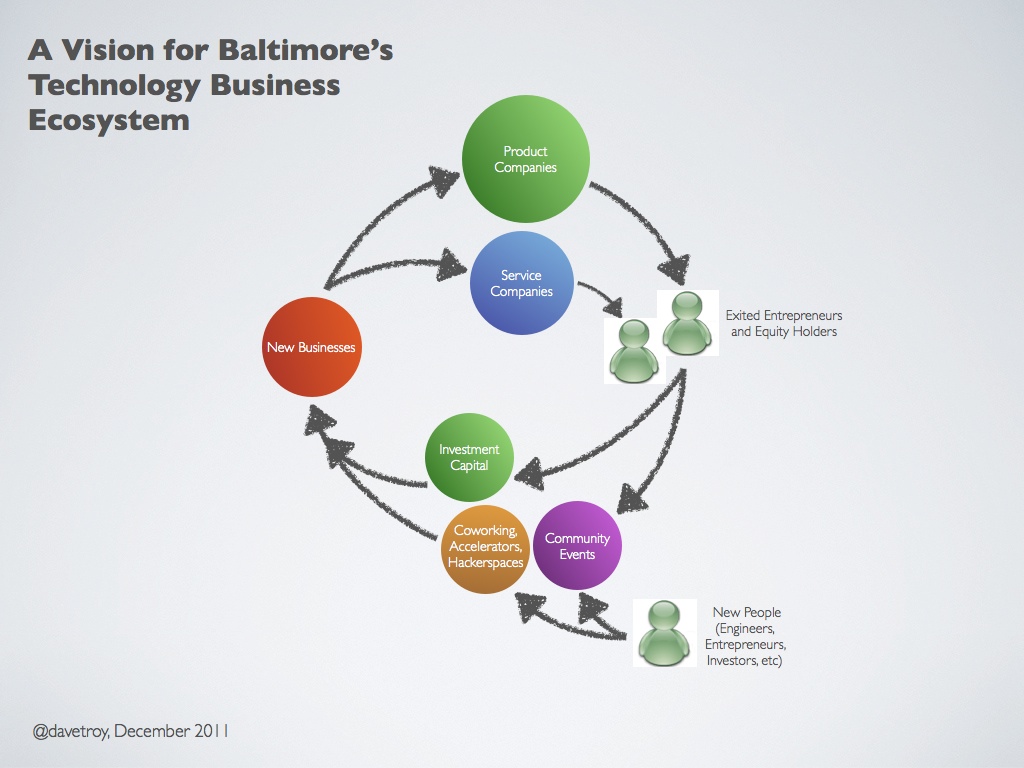
We’re all trying to build an ecosystem that looks something like this (click to enlarge):
Before we get into the specifics of this vision, here are a few basic values that underly it:
- People are the lifeblood of the community. The ecosystem requires educated, creative people. We should strive to enrich and build compelling opportunities for the people in our community.
- Businesses generate the wealth that powers our community. Strong businesses make a strong community. We should aim to make our businesses stronger and more valuable.
- There is a role for everyone. Diversity of expertise and background is essential to a strong business community. We should aspire to have a healthy mix of product companies, service companies, business service providers, and many types of venues and events for relationship building.
- We should celebrate our successes. Celebrating successes, whether they are successful exits or just milestones, is essential to creating a community that values growth, curiosity, and experimentation.
- We should connect people together. Trust and strong relationships are a precursor to new business formation. With strong trust relationships, we’ll have more new businesses and they will be more successful.
With this in mind, here’s how this model works, step by step. It’s a cycle, and for simplicity, we’ll start at the bottom.
- Getting into the mix. (6 o’clock) New participants, exited entrepreneurs, investors, hackers, new entrepreneurs come together via a mix of venues and events. By “venues” I am talking about spaces that offer opportunities for daily, ongoing interaction between individuals. They’re “high touch” while being “low risk.” Think coworking, hackerspaces, regular café coworking, incubators and accelerators, and educational institutions. By “events” I’m talking about one-off or periodic events that afford people an opportunity to get together, get to know one another, and try new things. (Think Bmore On Rails, Startup Weekend, EduHackDay, CreateBaltimore, etc.) New investors can participate in angel groups and pitch events.
- New business formation, access to capital. (9 o’clock) With trust, exposure, and experience, new businesses can form. With the prolonged exposure made possible by the “mix” phase, entrepreneurs can make more informed decisions about who to go into business with and have likely had more time to refine their ideas before ever beginning. This means a lower failure rate for new startups than in a less-developed ecosystem. As for investment capital, some will come from exited entrepreneurs, some from venture capitalists, seed funds, and governmental initiatives like TEDCO and InvestMaryland. We should aim to connect investors with nascent businesses. This will happen naturally to some extent in the “mix” phase, but we should consciously encourage it; bootstrapping should also be an option.
- Business growth. (12 o’clock) Some companies will grow to become strong product companies, others will become service companies. Some people want to grow their businesses to sell them, while others just want to build and run a great business. These approaches are all valid. We should celebrate the formation and growth of all of the companies in our ecosystem.
- Entrepreneur exits. (3 o’clock) Some entrepreneurs will seek the opportunity to exit their businesses and capitalize on their growth. This is most lucrative with product companies. When these exits occur, we should celebrate them as successes of the community as a whole.
- Entrepreneur returns to the mix. (6 o’clock) Exited entrepreneurs should be encouraged to re-engage with the community, either as investors or as active entrepreneurs to form new relationships and new businesses. The cycle starts anew.
That’s really it. If we can make this cycle work, we’ll have a thriving entrepreneurial ecosystem in Baltimore. (This is the exact same cycle that made Silicon Valley great, and is now working in places like Boston, Austin, and New York.)
That’s Great, But Where Do We Stand Now?
We have much of what we need in place: venues, events, investors, and businesses. But the two things we have most lacked are a cohesive vision for how this cycle is supposed to work, and also the last link in the cycle – systematically re-engaging entrepreneurs into the ecosystem.
However, just today came the news that Greg Cangialosi and Sean Lane are forming a startup accelerator in Federal Hill. That’s an example of two successful entrepreneurs getting back into the mix and re-engaging. We need more of that. But we need to make it easier and more attractive for entrepreneurs – there need to be obvious on-ramps and channels. We’re starting to get that in place.
My hope is that this vision, which I have shared in one-on-one conversations with many friends and leaders to much enthusiastic agreement, can now take root as the underlying force that animates our community.
Role of the Greater Baltimore Technology Council
There’s been much discussion about what the role of the Greater Baltimore Technology Council should be, and I submit that this vision, as I’ve articulated it here, is what the group has been moving toward for the last three years – and with Jason Hardebeck (who is himself an exited entrepreneur) at the helm, I believe we can move towards it more quickly now.
The GBTC’s job is to:
- Help build and protect the ecosystem. GBTC should be a watchdog that ensures the ecosystem has the right pieces in place and that they have what they need to function properly. This means working with government, educational institutions, and others to ensure that the conditions required for the ecosystem to thrive are present.
- Accelerate the cycle. The faster this ecosystem operates, the more successful we will be. Specifically, GBTC should connect people together, and celebrate our collective achievements, and help pull our educational institutions into the ecosystem. Ultimately this will pull in more smart, creative people, accelerating the cycle further.
- Make our businesses stronger. By connecting our community together better and providing venues, events, connections, and celebrating our success stories, GBTC can help to make each of our businesses stronger and more robust. This also means connecting businesses to service providers (HR, insurance, accounting, legal) and mentors who can provide value.
For all the drama and hand-wringing, it really is this simple!
Some have wondered whether they “belong” in the GBTC. That’s something every person and entrepreneur has to decide for themselves; there are obviously many valid and valuable ways to participate in this overall vision that are outside of the scope of the GBTC. However, if you care about growing and protecting this ecosystem, and if the group can help your business grow and succeed, I’d encourage you to lend GBTC your support; it just makes good business sense, as GBTC is the only group that has been tasked with this important work.
I know that others in positions of leadership in Baltimore’s tech business community (and at GBTC) share this vision. I encourage your comments and feedback, but before reacting, you might take some time to really think this over. This is something I’ve been looking at for several years, and based on everything I know, this is the right way forward.
The Rest of the Story
Oh, and there’s one more thing.
We all want to prime this pump and get this vision more fully underway, but I also think it’s reasonable to ask how Baltimore’s tech ecosystem fits into the bigger scheme of things. What relationship should we have with other ecosystems, in our region and around the world? Is the point to win or are we trying to thrive? I’ll be touching on this topic in an upcoming post, and it should help to clarify how this vision makes even more sense for Baltimore.
January 23rd, 2011 — business, design, economics, geography, social media, software, travel, trends

50% Off Loaves and Fishes…
Every few years a company emerges that grows so swiftly that it manages to define the zeitgeist and often helps to inflate a bubble that defies any rational explanation. Often these businesses are driven by new, disruptive ideas that take the market by storm and create a real shift in how people do things. Amazon (and online shopping), Google (and the search business), and Apple (music, smartphones, and touch computing) fall into this category. They created real, thick value.
For every one of these, there are others that grow, get tremendous buzz, and then seem to dissipate as quickly as they emerged. Or they settle into a kind of staid middle-age, their torrid teen years long forgotten. Think about 90’s darlings like IOmega, Boston Chicken, eBay, and Home Depot. It can be difficult to predict which businesses will stick around and which will fall away (or become low-growth, boring enterprises).
Groupon has emerged as the “Jesus Startup” of 2010-2011. The industry always needs one, and they tend to conform to an archetype and have a mythical story: the visionary CEO (Marc Andreesen, Evan Williams, Mark Zuckerberg) who experiences a remarkable rise to greatness. For this story and for these 15 minutes, we have Andrew Mason, the humorous and self-deprecating everyman who declares of the fledgling Groupon, “We could still fuck this up.”
The implication is that they’ve done something to “ace” it so far. But the truth is that they are just regular guys that started out doing something else (some kind of social mission charity stuff – blech – don’t talk about that, it’s not compatible with the visionary myth). And after executing on their original idea and experimenting a bit, they found themselves in the middle of a new exploding business model. Kudos for that. But as is the case with most “Jesus Startups,” there’s been a notable lack of critical thinking about what happens next.
Here’s where I think Groupon is weak.
1. Over-reliance on hypergrowth.
Groupon has posted some crazy huge numbers as they push through massive expansion into new markets. When you are turning up a new major metropolitan area every few days, gross revenue numbers are going to grow very quickly as businesses rush to be part of adobe something that’s got so much buzz. As their geographic footprint stabilizes, top-line revenue will start to level out. When that happens, the business becomes much less interesting and has a lower upside (see Home Depot, Gap, Boston Chicken, Microsoft). This is why a push to IPO while this hypergrowth is happening seems to be a priority for the company.
2. Customer fatigue.
If you have been using Groupon, Living Social, GILT, HauteLook, or any of the countless other sites that rely on daily emails to get their message out, I’ll bet your experience has been something like this: at first you reviewed the emails every day; you bought a few things; you are now buying almost nothing; now, you may not look at the emails at all; you still have unused Groupons. Time is money, and people have too much crap. Eventually, people are not going to take the time with this. And when Groupon has exhausted all the “easy hits” that drive people to buy, then what? Besides, I thought email was “dead” and for “old people.” Right? Or did I miss something? (Sure, the deals spread through Facebook or whatever social channels, but email is a huge part of the business model.) As younger folks steer away from email, it’s an open question whether the current “daily deal” model can be sustained.
3. Business fatigue.
Businesses are tripping over themselves to be part of the latest new thing and expose themselves to thousands of customers at a shot. And sure, a Groupon deal can be a great opportunity for some businesses. But many businesses (some say up to 40%) have found that doing a Groupon deal can be a costly mistake that actually damages their business. The economics of the deals deliver a fraction (typically 25%) of the face value, which often does not cover their costs. While there is some breakage (unused deal revenue that can offset losses), this still may not cover the cost and hassle the promotion entails. Additionally, businesses that undertake in smart advertising can promote themselves all year round. A business can do a Groupon deal at most once every few months – otherwise the deal just doesn’t seem “special” enough. Groupon is a great novelty that can help some businesses become better established, but I really wonder if many businesses would participate more than once or twice, when compared to ongoing targeted marketing initiatives.
4. Scale as the only barrier to competition.
There are now thousands of competitors to Groupon (Living Social is the largest). There will be thousands more. The reason why both companies have received such massive investments to date is that they need to get big to create a local sales force in every market in the world, which is obviously an expensive proposition. If they can get sufficiently big, they can build a sustainable business that will dissuade new market entrants simply because any competitor would have to build a worldwide localized sales force. And if you’ve ever had to run a local sales force, you know that it’s a very expensive, messy, people-driven business. The business that Groupon will eventually most resemble structurally is the Yellow Pages. With sales teams in every city, the major directory publishers were able to exert a near monopoly control over the interface between local businesses and consumers, and Groupon is going after the same market. The difference is in Groupon’s use of technology and use of social. Otherwise, the two businesses are nearly indistinguishable. The assumption is that Groupon’s scale will prevent competitors from gaining a foothold, but I don’t see any real reason a focused local competitor couldn’t develop a sustainable business.
5. Tone-deaf on China.
Groupon has undertaken a massive push to expand into China. That sounds great, and any US investor would likely salivate over such an aggressive, prescient-sounding move. Ah, that Mason guy, he really knows his stuff. But my friend, China-expert Christine Lu tells me that Groupon’s Berlin office has recruited 1,000 new hires for China in the last three months – many recent college graduates. But here’s the thing. I’m currently getting a daily deal from a site in Shanghai called Wufantuan that’s indistinguishable from Groupon. (50% off Mexican food in Shanghai was one recent deal.) If you know anything about the Chinese market, you know it favors locals and cloning is part of the culture. To expect Groupon to be able to achieve anything meaningful in China is wishful thinking. Google got run out of the country on a rail. You expect the powers that be there to allow a US firm to “split” revenues with Chinese businesses to provide its budding bourgeoisie with deals on burgers, skydiving, and cupcakes? Um, yeah. OK. If there’s a business there, it will be Chinese. The entire Groupon strategy with China is theater, designed to show investors that they’re “paying attention to that market” while they ready the IPO.
So, the real deal of the day is for Groupon itself. The question is whether there’s enough upside in the model – and enough “bigger suckers” out there for the average Joe to make any money on the offering before the business model settles out and becomes the next eBay, Home Depot, or Gap. These are fine, sustainable businesses, to be sure, but all are way less sexy than they once seemed. (Yes, for about 6 months in 1995, Gap was incredibly sexy.)
Before you decide that Groupon’s the next hot young thing, it’s worth asking whether you want to jump on this model right now. I believe there’s a really nice, long term, but ultimately very boring business in there that should pay a nice dividend. Meantime, the visions of hypergrowth are likely much exaggerated.
I certainly can’t criticize the trajectory that Andrew Mason and company have managed to carve out for themselves. It’s an incredible story and it’ll be fascinating to see how it unfolds. The expectations are so high, they really can’t be met.
My bet is that they will need to move on to more sustainable forms of year-round marketing for businesses and away from the aggressive 50% discount model. That’s a much less sexy place to be and it will require some real creativity to carve out a niche there. But I just don’t buy the idea that they can continue to build a business based solely on deals of the day at such aggressive discounts.
The Groupon model right now is based primarily on creating new relationships between businesses and customers. They’ll be on to something really interesting when they can help to nurture and sustain those same relationships profitably.
I originally posted this as a Facebook Note on January 22nd, and posted it here with a few slight editorial modifications. There are some good comments regarding China that are worth repeating here. There are also many good comments on that Note that are worth checking out.
From my friend Christine Lu (@christinelu):
Thanks for the mention Dave. I think they’re hiring 1K in the next few months. As in currently in the process of. Things over there have just sounded a bit weird to be a sustainable market entry strategy so I think it’s all a nice way to have a China story to prop up the IPO. The elusive vision of 1.3 billion people using Groupon. Nevermind that clones are already saturating the market and they’ll have Alibaba’s Taobao to deal with. Anyways, we discussed it a bit on Quora.
From my friend Vivian Wang (@vivwang):
The JV is a positive differentiator for both companies and will accelerate market consolidation. There are 1686 other group shopping sites as of December, yet only 29 sites have CIECC licenses to legally operate. Some believe there are only 10 serious contenders that can attractively compete. The real threat is Alibaba and Taobao, so a more international footprint into China seems warranted. One of the smarter things Groupon did was buy Mob.ly back in May, which has been developing on all mobile platforms. For a sector that’s already doing about $79B in transactions, I think the risk seems worth taking.
…
Hope something truly uniquely innovative comes out of this that the world has yet to see. I’d personally love to see Tencent migrate from selling a $1B of games & virtual goods to some seriously tangible merchandise. The foolish side of me actually thinks they’ll have a fair shot at it. Should be fascinating.
And from my friend Francine Hardaway (@hardaway):
I believe all this bargain stuff, especially in the US, is part of the recession and will go away when it is over and we all relax. I agree with you 100% on Groupon’s model; I am done buying stuff I don’t need, even at half price. All the people I know who love coupons (I never have) are armed with sheaves of them, and all that happens is the merchants are in price wars with one another in a race to the bottom. Sites like Groupon and Haute Look might be marketing front ends, but they are also margin-shavers for the people in the businesses they market. This HAS to be unsustainable at the end of the day, whether China is successful or not (and I bet it won’t be, because of all the people who, when we were in China, got up and said they would clone our products in half an hour).
What do you think about Groupon?
October 6th, 2010 — baltimore, business, design, economics, geography, socialdevcamp, software, travel, trends
Occasionally we here in the burgeoning tech community in Baltimore have paused to take stock about how far we’ve come, and what would be good to do next. About a year ago, Mike Subelsky made some suggestions on the BaltTech blog, and he’s recently identified some awesome emerging leaders who have made a real difference in the last year. Many of the ideas he identified are ones that people have taken up and run with.
In my travels in the last year, I’ve come across several ideas that are working in other places that we should consider pursuing here – in no particular order.
- Startup Weekend – Bring together a bunch of startup-minded people on a Friday, form groups, and build something entirely new from scratch by Sunday. Demo it on Sunday afternoon. I had the chance to attend StartupWeekend Seoul this summer and it was a great experience. Lots of relationships were formed and some truly great ideas were unearthed. We need a big-ish place where folks can hang out for 3 days straight and someone to take the lead.
- Girls In Tech – This organization is a global group of women who are making a real difference in the tech community. Some have griped about the name, and I agree it’s somewhat problematic – however to their credit they are trying to do their best to attract young women involved in tech and create a culture that is at least somewhat fun and edgy. Behind the scenes, its founders and main movers and shakers are some of the most intelligent and connected emerging women leaders in the tech world; with strong leaders in China, New York, and San Francisco. I promise you that a Girls In Tech Baltimore chapter would find good connections worldwide.
- Founder Dating / Find-a-Cofounder – These events have been popping up in San Francisco, Seattle, and New York in various forms. The idea here is that if you can bring together a ton of people who all have a clear intent to want to form a startup – if they can find good partners to work with – maybe something will come of it. This seems like a great way to unearth “startup-curious” folks in boring jobs and pair them up with ambitious entrepreneurs who just need a strong partner. And every other combination. Worth doing. (And it looks like a meeting may be happening next week to start the conversation!)
- Hacks and Hackers – Baltimore has the critical mass to support a chapter of this group that aims to connect journalists and tech/developer people. And entrepreneurs. News here is horribly broken and it’s going to take an entrepreneurial mindset to fix it. The sooner we can get journalists and smart startup people to get to know each other better, the sooner a new model will be discovered. Get on it.
- TEDxBaltimore – I helped pull together TEDxMidAtlantic in 2009 and 2010, and TEDxOilSpill this summer. TEDxMidAtlantic aims to throw a spotlight on a wide range of creative thinkers in and around our entire region. Mel Brennan from YMCA of Central Maryland and Open Society Institute have been discussing a potential collaboration to help produce TEDxBaltimore, which would have the opportunity to focus on Baltimore and its future potential. I strongly support this and anyone who would like to step up will find support from YMCA, OSI, and TEDxMidAtlantic. Contrary to some recent tweets, no date has been set.
- Entrepreneurs Unplugged – This event in Philadelphia features an entrepreneur on stage to discuss their story, successes, and failures. As long as they can keep from lying on stage I think this could be an extraordinarily powerful format. GBTC has had a Face2Face program for several years, which avoids the tendency that entrepreneurs have to whitewash over failings and details by pulling together a very small group over dinner. Both are awesome.
- Reverse VC Pitch Party – My friends Larry Chiang and Dave McClure have been dreaming this one up, so VC’s can do “outreach and education and stimulate deal flow.” I think it’s a great idea and I’d love to see groups like my own Baltimore Angels as well as some of the VC firms in the region get up on stage and talk about the deals they like to see, the reasons startups should seek them out, etc. A great way to turn the tables and share perspectives that are all too often misunderstood.
- CityCamp – In the spirit of BarCamp and SocialDevCamp (both of which could use folks to take the charge for updated events – we’ll all help!), CityCamp is a catalyst and a forum for talking about what’s working and what still needs to be done from an Open Government / Gov 2.0 standpoint. It’s what Baltimore City’s well-intentioned “Data Day” this summer perhaps should have been. There’s a lot of potential for involving folks from the design, architecture, and foundation community here too.
- Junto & Salons – Ben Franklin convened a regular gathering of smart folks in Philadelphia, many much older than himself, to discuss ideas of the day and to trade notes about what businesses had gone bankrupt and the like; he called it a Junto. Lately I’ve noticed an increasing number of evening salon conversations about politics, startups, tech and the like. Our friends in Philadelphia revived the Junto tradition a couple of years ago, with awesome results. We’ve discussed doing it here but it hasn’t happened yet. Are you the charismatic leader?
- Bootstrap Baltimore / Mosh Pit 2.0 – For the last two years Jared Goralnick has put together Bootstrap Maryland at University of Maryland’s College Park campus. This is a great event, and we could use something here in Baltimore that is aimed at drawing out the amazing quantity of entrepreneurial talent here in Baltimore’s many universities. A few years ago, GBTC hosted an event called MoshPit – a business plan competition for college students. We need to revive this program and meld it with something like Bootstrap. And we especially need to reach out to students in engineering, science, and the arts – not just business students.
Go ahead and steal these ideas. There are plenty more where these came from. Borrowing working ideas from other places means they have a much higher chance of success than trying to design a totally new event format from scratch. Plus, it gives the potential for direct exchange with organizers elsewhere.
If you are interested in pursuing any of these ideas, ping me – I can put you in touch with the originators of these events. And thanks again to everyone who has stepped up to make a real difference here. We are changing this city one mind at a time.