October 9th, 2010 — baltimore, business, design, economics, geography, philosophy, trends
Some have predicted that high energy costs, either due to decreasing supply of oil or costs associated with carbon emission mitigation, will soon push people out of their cars and onto public transportation.
But there’s something else happening: people are getting sick of spending time in transit at all, making city living increasingly attractive. We are now increasingly able to infill “scrap-time” during our days with useful activity, and location-based social networks make it possible to maximize personal connections as we move about. We are engineering our own serendipity to generate real value from every moment. Why would we squander that potential by spending time in transit of any kind?
In the future, I predict:
- Air travel will be reserved for trips greater than 500 miles
- Trains will be used for trips less than 500 miles
- Bicycles, walking, and local transit will be used within cities
- Any local trip longer than 20 minutes will be seen as burdensome
- Cars will be seen as a luxury to be used for road-trips + utility hauling
And again, this will not happen due to fuel scarcity alone – it will happen because people demand it; and I’m not talking about you – but your kids and grandkids.
Regardless of what happens with fuel prices, we know that roads do fill to their available capacity. And then that’s it. Expansion does not help for long, because roads then fill to whatever capacity is available and development occurs until roads are too broken to use.
Roads are also increasingly expensive to build. A major construction project such as the popular-but-doomed Intercounty Connector in Maryland will cost over $2.6Bn to build. Is this a good long-term use of resources? Seems to me we’re throwing a bone to some 55 year-old commuters who have been annoyed with the state of the Washington Beltway since it was built, and this is the only solution they thought could fix it. Enough with the reductionist, idiotic causal thinking already: it’s a dumb idea. I don’t begrudge it, but in the long term, who cares?
The idea-driven creative industries that America has hung its hat on can only thrive in cities, where people can get together and trade ideas freely. Any barrier to that exchange lowers the potential net economic value. Put simply, all of this kind of creative work will happen in cities. Period. Because if we don’t do it in cities, we won’t be able to compete with our peers around the world who will be doing this work in cities.
So, what of the suburbs? In many European cities, the urban centers have been long reserved for the upper-class elites; poorer immigrants, often Turks and other Islamic communities, tend to inhabit the outer rings of the city – denying them crucial access to economic opportunity. This kind of social injustice is baked into many European cultures; in France, you are simply French or not French, and no amount of economic mobility will allow someone who is not of that world to sublimate into it.
This is not the case in America. We are all Americans, and even marginalized citizens are able to fully participate in all levels of our culture – though certainly there is social injustice that must be overcome.
Over the next 50-75 years, there will be a net gain of wealthier people in America’s cities and also a net gain of poorer people in our suburbs. This will be a natural byproduct of an increasing demand to be in cities, and an increasing (and aging) suburban housing stock coupled with roads that no longer function.
To fulfill our challenge as Americans, we must use these dual gradients in our cities – the inflow of the rich and the outflow of the poor – as an opportunity to maximize social justice. By avoiding flash-gentrification and fixing education as we go, we can in a span of 20-40 years (1-2 generations) offer millions of people a pathway into new opportunities that stem from real, sustainable economic growth; all the while realizing this is going to mean more color blindness all around – and that suburbs will generally be poorer than the cities.
In my home state of Maryland, the only foreseeable damper on this force is the federal government and the massive amount of money it injects into industries like cybersecurity and other behemoth agencies like the Social Security Agency.
Because these agencies and the companies that service them generally do not have to compete globally to survive, they can locate in the suburbs and employ people that live in the suburbs – and subsidize all of the inefficiency, waste and boredom that comes with that.
This is nothing but a giant make-work program and its benefactors are little more than sucklings on the federal government’s teat, which is spending money that will likely come straight out of your grandchildren’s standard of living. Right on.
Cybersecurity, for all its usefulness in possibly maybe not getting us blown up by wackos (bored wackos from the European Islamic suburbs, I’ll point out), is nothing more than a tax on bad protocol design. For the most part it doesn’t create any new value. In the end, we’ve got suburban overpaid internet engineers fighting an imaginary, boundless war with disenfranchised suburban Islamic radicals. Who’s crazier?
Lastly, for all of you who think I’m wrong or resist these predictions because you personally “wouldn’t do that” or can produce one counterexample, I ask you: Are you over 35? If so, your visceral opinion may not matter much. I fail this test myself, but I believe my argument is logically sound and is based in the emerging attitudes of young people.
The future will be made by people younger than we, and based on everything I can see, we are on the cusp of a major realignment of attitudes and economics in America.
It won’t be too much longer til active, entrepreneurial creative professionals (black and white) in our cities look at the suburbs (black and white) and decry the entitlement culture of the suburban welfare state.
March 28th, 2010 — baltimore, business, design, economics, geography, philosophy, politics, software, trends
There’s been a lot of speculation about Google’s plans to deploy Gigabit fiberoptic Internet. Where will they deploy? What are the criteria? How many homes will they serve? Will they favor cities, or rural areas?
Your guess is as good as mine. But as a part of the global tech community and as someone who has spent a lot of time at Google and with people from Silicon Valley, these are my guesses about what they might do.
Cities Offer Higher Returns
Cities have the kind of density required to deliver a lower cost-per-home deployment. Less cable, a single point of negotiation and contact, and the ability to deploy using lateral construction from fiber conduits means lower overall costs.
Multi-family housing means more customers per square mile. Baltimore has a city-owned conduit system which can serve over 90% of the area of the city — without requiring the use of poles or negotiating with third party utilities.
Rural Areas Cannot Be Served Profitably
Telephone companies receive funds from the Universal Service Fund to subsidize service in areas that otherwise cannot be profitably served. Google is not subject to the regulatory framework (Communications Acts of 1934 and 1996) that would give it access to USF funds; in fact, it has every incentive to fight to avoid falling under such regulation.
Google is not a charity, it’s not being subsidized by the government, and it is not a monopoly. There is no special reason why Google should care about making services available in rural areas, and there is certainly no profit motive. Rural service requires fuel, vehicles, and people on the ground. Every part of this is expensive; it’s why it loses money and why it has to be subsidized by USF funds.
Google simply has no motive at all to serve rural areas. I’ll eat cat meat if Google selects a rural area for this trial. It just won’t happen.
Tech Is Opinionated
Google has opinions. In the tech world, people take a stand: Google and Apple both expressed strong opinions about how a smartphone ought to operate. Opinionated software is an emerging trend in software tools. Software designers bake their opinions into the tools they create. People who use those tools end up adopting those opinions; if they don’t, the tools become counterproductive, and they are better off using different tools.
There is every reason to believe that Google’s opinion is that the suburbs are obsolete, and that that opinion will inform their strategy for building out a fiber network. Here’s why Google likely believes the suburbs are obsolete:
- Suburbs rely on car culture, which consumes time; that’s time that people can’t spend on the Internet, making money for Google.
- Suburbs are not energy efficient, requiring lifestyles that generate more CO2 emissions. Google has said it wants to see greater energy efficiency in America.
- Google CEO Eric Schmidt has said he wants to see America close its innovation deficit. There’s nothing innovative about the design of the suburbs. It’s a tired model.
- Schmidt has supported Al Gore politically and in his efforts to combat global warming. Regardless of what you might think of Al Gore or global warming, we have a pretty good idea what Google thinks of the issue.
- Gigabit Fiber in cities could utterly revitalize them. We’ve been looking for ways to fix our cities for the last 50 years. The last renaissance was powered by large-scale economics; a new renaissance can be launched with large-scale communications investment.
- Google’s employees are young, idealistic, and believe in self-powered transportation. It’s worth pointing out that the Google Fiber project lead, Minnie Ingersoll, is an avid cyclist.
The Suburbs Are Done
I’ve said it before. So have others. But I’m not promoting that they be subject to some kind of post-apocalyptic ghettoization, either, so calm down. No one’s threatening your commute or your backyard barbecue.
But what I am saying is that at some point we need to take a stand about where we’re going to invest in our future. About where we believe we can regain competitive advantage and efficiency.
I believe our only hope to do that is with smart, well-designed urban cores, connected with world-class communications infrastructure and fast, green, and efficient people-powered transportation. And I think Google believes that too. Bet on it.
December 12th, 2009 — design, geography, philosophy, travel, trends
Having just returned from the Le Web conference in Paris and having once again thoroughly enjoyed their Velib’ municipal bike-sharing system, I continue to be inspired to do as much as possible via bicycle.
I try to bike as a form of functional transportation, not just for exercise. If you start to think about biking as a way of getting around, a lot of the dysfunctional design of our cities and suburbs becomes evident.
Today our family was faced with the task of obtaining a Christmas tree, and wanting to get out for a bike ride I immediately thought this was something we could accomplish via bike. This summer when I attended TED Global in Oxford, I flew to Heathrow airport with my bike and then rode from there to Oxford (about 50 miles) with a 30 pound pack on my back. So a Christmas tree (20 pounds?) over 5 miles seemed no problem in comparison.
So this afternoon our family biked to a local produce stand and purchased a tree. We put it into a US Army standard-issue duffle and secured that to my back using cargo straps.
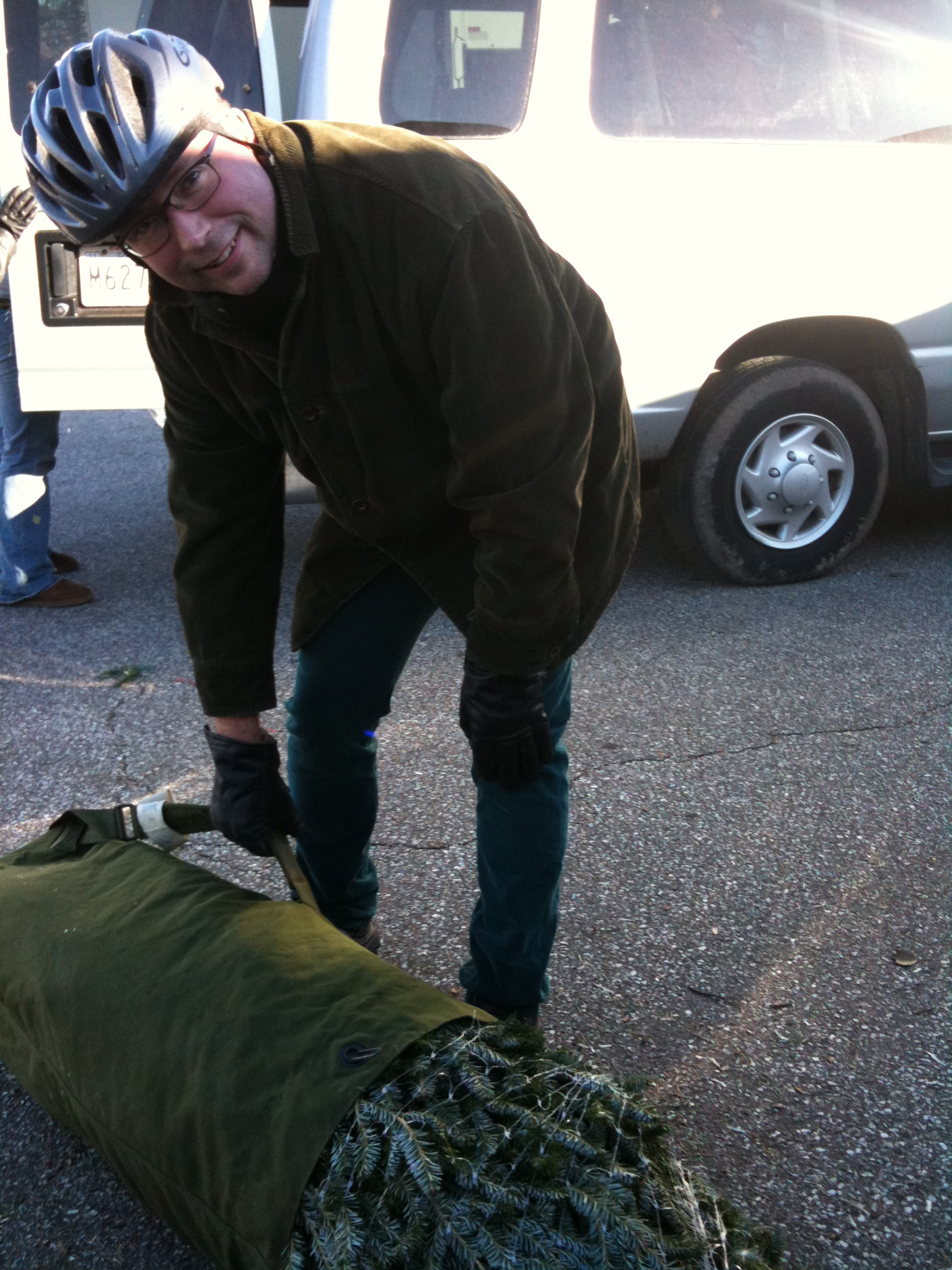
Here’s me in my fully mobile glory:
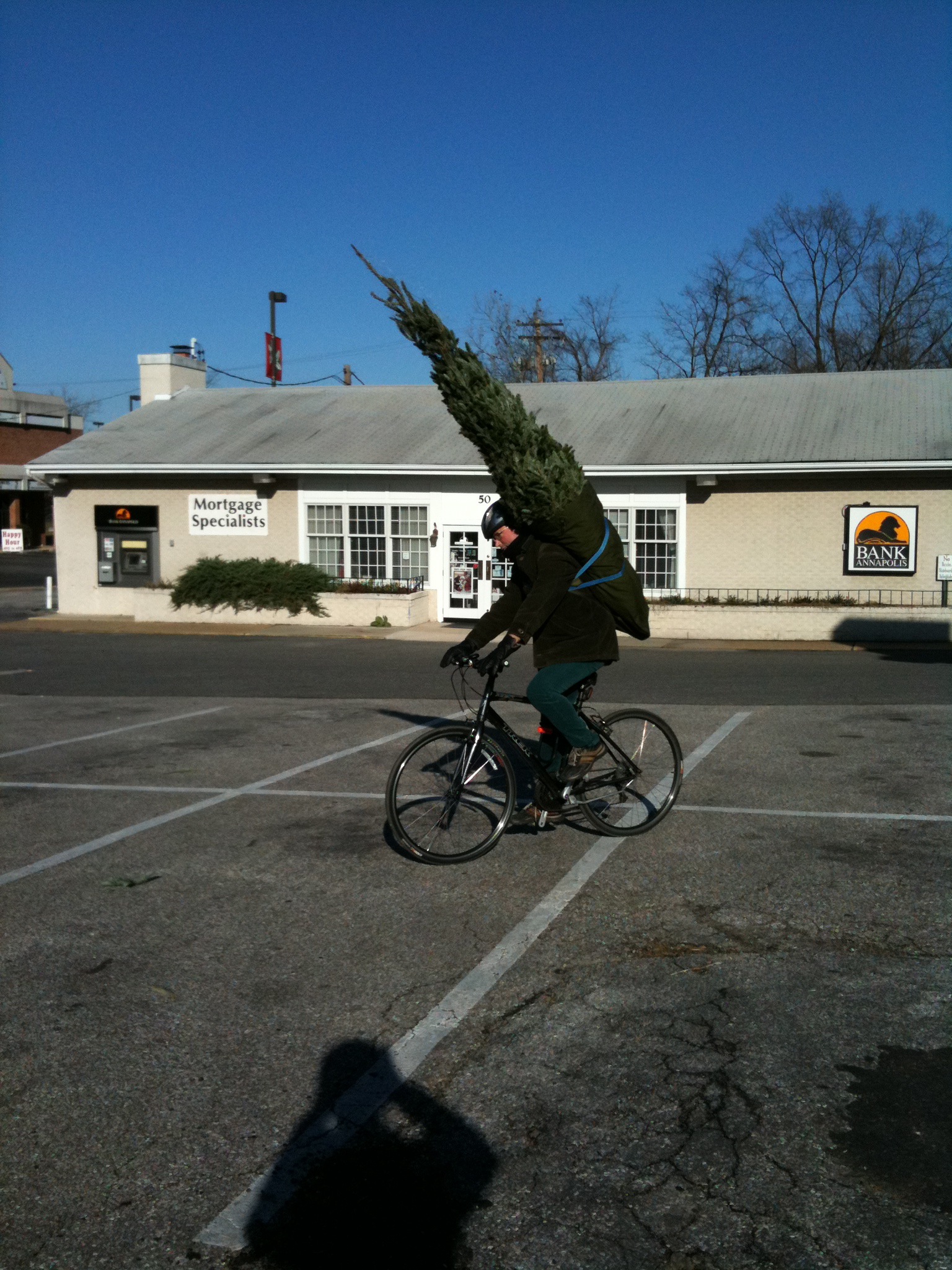
And here, on the Baltimore-Annapolis Trail:
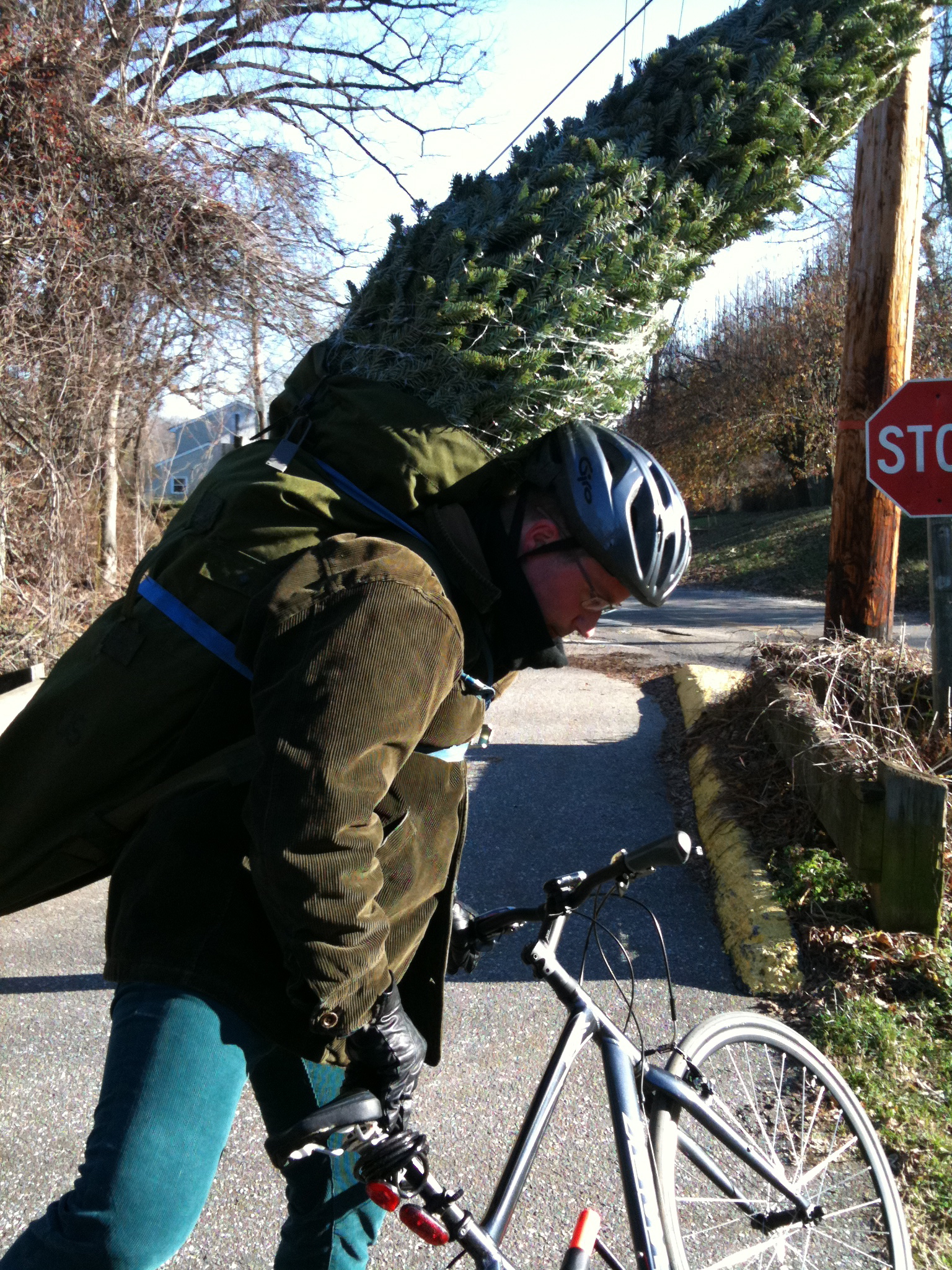
This crazy getup evoked smiles all the way around. Many people said, “You’ve just made my day.” It was about a 30 minute trip home, and somehow a clichéd act of holiday duty had been transformed into something joyful.
I just wanted to take a few moments to reflect on 2009 and express my gratitude for an amazing year:
- The wonderful community we have discovered and built up at Beehive Baltimore (February-present)
- My old friends at Twitter and at AngelConf + Y Combinator, Silicon Valley (March)
- New friends + allies exploring the future of journalism in Baltimore (April)
- New friends and compatriots in Buenos Aires, Argentina (April)
- Jared Goralnick and his amazing Bootstrap Maryland event (May)
- Aaron Brazell, Jimmy Gardner and WordCamp Mid-Atlantic (May)
- Brady Forrest, Ryan Sarver, Anselm Hook, Andrew Turner at Where 2.0 and WhereCamp (May)
- Barcamp Baltimore (June)
- Micah Sifry and Andrew Raisej at Personal Democracy Forum + Transparency Camp (June)
- Dave McClure, Christine Lu, and the Geeks On a Plane #goap gang (June)
- Great new #goap Friends in Tokyo, Beijing, and Shanghai (June)
- Christine Lu, Chris Anderson, Lara Stein, Salome Heusel and the TEDx team (June)
- An Amazing experience at TED Global in Oxford (July)
- Winning Innovator of the Year Award from The Daily Record (October)
- Winning the Connector award from Greater Baltimore Tech Council (October)
- The entire TEDxMidAtlantic Team (August-November)
- An AMAZING life-changing event: TEDxMidAtlantic (November)
- New friends at Le Web in Paris (December)
It has been an incredible year. If you follow your heart, anything is possible. Don’t let anyone tell you something can’t be done. Strap a Christmas tree to your back if you want to. It’ll work.
Do good work, my friends, and get ready for an amazing 2010. We need each other.
Best wishes for a safe and happy holiday season, from my family to yours.
December 15th, 2008 — design, economics, politics, travel, trends
I just returned from Paris and the formidable Le Web ’08 conference that Loïc and Geraldine Le Meur hosted there, and really had a great time! I will write more about the conference shortly.
Meantime, you may have heard that Paris has installed a network of bicycle stations throughout the city and that they are available for folks to use for their commutes, errands, and to generally replace cars and other forms of transport where possible.
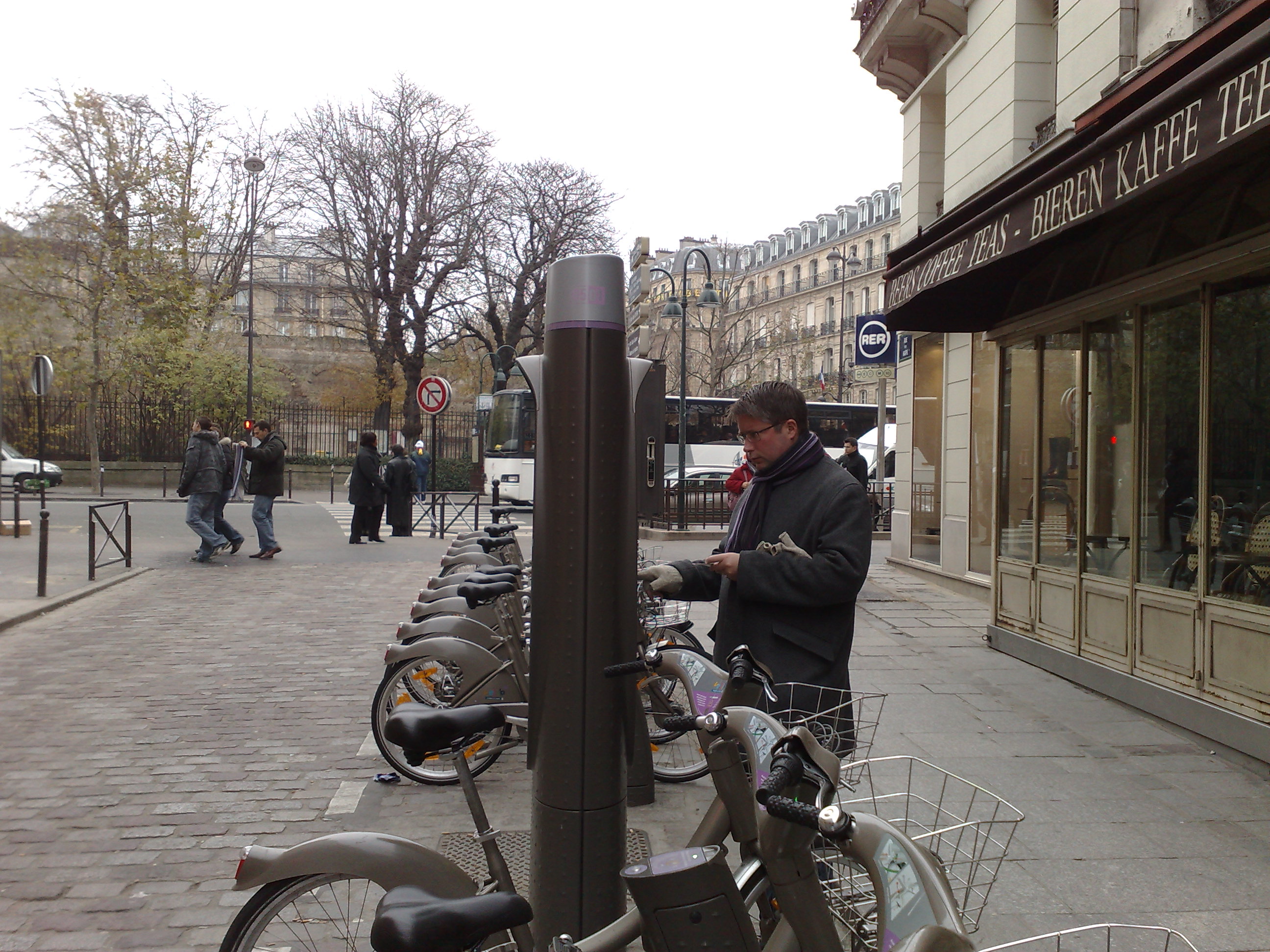
What the press has not reported so well is that these bikes are FREE for trips under 30 minutes (with a very reasonable 1 € /24H subscription), and that it is EASY for tourists to use the bikes. Often, European ticketing machines require credit cards which utilize a smart-card chip, but Paris’ Velib’ bikes have no such requirement.
Here’s how it works:
- Arrive at a bike station and select English as your desired language
- Select “Short term subscription” and choose a 24-hour (1 €) subscription or 7 day subscription (5 €)
- You will guarantee the bike with your credit card for up to 150 €, but you will only be charged if the bike is not returned
- You’ll be given a ticket with a subscription number good for the duration of your subscription
- Follow the directions for taking a bike, and grab one (warning, pick one with good tires and check the seat to be sure it stays up)
- Take a bike
- Return it within 30 minutes and your rental is free!
- Enter your subscription number when you return the bike to confirm the return; the bikes have active electronics that detect the station, so this may not be strictly necessary, but it’s a good idea
Now, at first the requirement to return in 30 minutes may seem like a problem, but it’s not: there are stations every 300 m throughout all of Paris, and you will see these stations everywhere. So, these bikes are great for touring! Bike for a bit, return the bike when you are near your destination or see something interesting, and then walk, train, or meander wherever you like. You can pick up your next bike wherever it’s convenient, and you never have to worry about locking up your bike, leaving a rental bike in a sketchy neighborhood, or having to go back to where you parked your bike. It’s by far the most carefree and fun travel bicycling experience I’ve ever had.
Occasionally, the station where you would like to return a bike is full. If this happens, you can enter your subscription number at the kiosk and it will give you a map of nearby stations (there should be 3-4, as they are placed every 300m). The system also issues you an extra 15 minutes of free time to get to the other station, though in practice 5 minutes is usually all that is required.
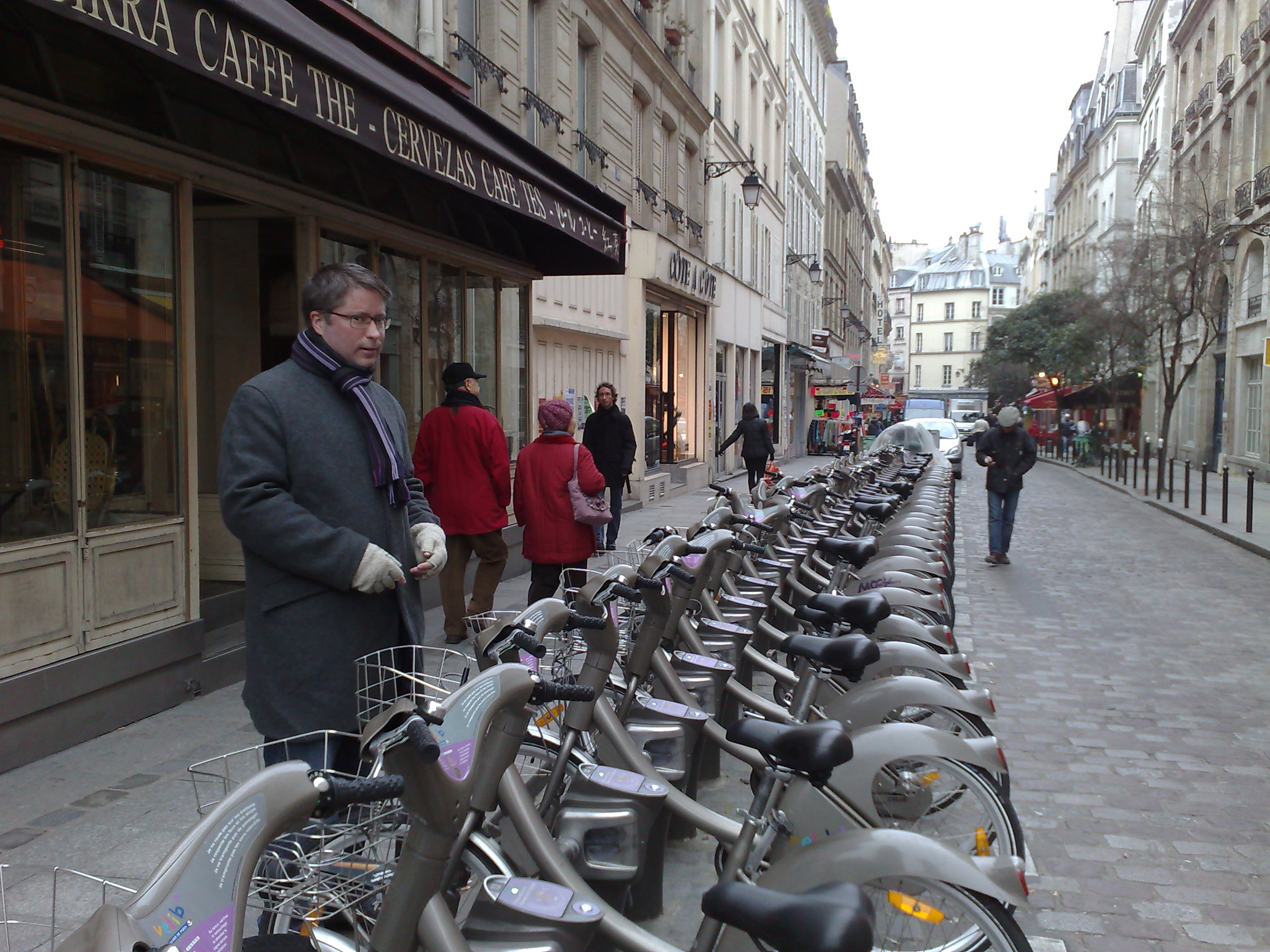
We literally did not think that we were going to use these bikes because so many of the articles we read said things like, “These bikes are not great for tourists because they require a European credit card and cost a lot of money if you keep them all day.” And yes, if you keep the same bike all day, they charge something like 4 €/hour after 2 hours. However, the cure for this is simple: don’t keep the same bike all day. Up to 2 hours the rate is something like 1 € per hour and not nearly as expensive as a traditional bike rental. And who wants to bike for more than a half hour anyway? Paris is all about stopping, checking out unique neighborhoods, grabbing some cheese and wine, and exploring. For this, Paris’ Velib’ (short for Velo Libre — free bikes) is perfect!
Other cities (and counties) should follow Paris’ lead on this. It’s a great system, run by advertising giant JC Decaux in exchange for outdoor advertising rights in Paris. No small trade, but the the benefit to the people of Paris (and to its visitors) of having a well run system for replacing cars is huge. If you have not been to Paris before, this should encourage you to go; if you visit often, please try the Velib’ bikes!

And yes, biking in Paris is somewhat entertaining. While they don’t have as developed a system of bike lane markings as in, say, Berlin, it is functional and you quickly get a feel for where it’s a bad idea to be biking. Shooting across the Seine to the Rue de Rivoli at 9:30 at night proves to be a bit harrowing, but you have the right of way and people are genuinely interested in not killing you; it would be a bureaucratic nightmare for everyone involved.
So, I can’t recommend it highly enough. Go to Paris, grab a bike, and have a great time!