Entries Tagged 'social media' ↓
October 24th, 2009 — business, design, economics, social media, software, trends
Technology investment bubbles have given many entrepreneurs the impression that success in tech is all about coming up with a “cool idea,” pitching it to a VC, getting funding, building up the business, and then exiting in high style.
First, this is a fairy tale, second, this will not happen to you, and third, what you’re observing is the product of a highly evolved network of peers, of which you are likely not a part.
What Happens in Palo Alto Stays in Palo Alto
What you see taking place in Silicon Valley is the result not of people betting on “cool ideas,” but of people betting on teams and connections. Before every VC deal, there is an exit strategy in mind. Every VC-backed valley startup is an outsourced R&D play.
Ever notice that many large tech firms grow primarily by acquisition? Most have comparatively lean R&D operations; this keeps experimenting off of their balance sheet, thus improving profits and lifting stock prices. Those stock prices are what give them the fuel to make good sized acquisitions, which in turn is the incentive for startups to grow and for VC’s to fund them.
This is the capitalist cycle in its most fully evolved form. Sometimes those acquisitions work out, sometimes they don’t, but the process feeds the machine and it becomes self-perpetuating. This process is literally the grist for the innovation mill that is Silicon Valley.
Why You Should Forget About VC’s — For Now
If you’re not already plugged into this world (meaning you have a lot of contacts there and have a specific idea of a strategy to get funding and an exit before you start), you probably have no place talking about VC’s at all. So ban it from your vocabulary. They’re not interested in you and won’t be. Yet.
Instead, think about how you’re going to build value outside of that network. It is totally possible, but don’t get distracted thinking about VC’s when you should be thinking about bootstrapping and investment from friends, family, and angels.
The good news? Most software startups can be launched for $50K or less these days. Build the minimum viable product, ship it, and then follow lean startup methodologies to iterate towards something that is valuable to the market. Once you have done that, established a revenue stream and can demonstrate some reason why venture capital investment will help you grow fast and capture a market position that you couldn’t capture otherwise, you may be ready to talk to a venture capitalist.
But more likely, investors will come to talk to you! If your startup shows real promise, VC’s will likely seek you out. If you work with some angel investors, they will likely have networks that can help you secure a next round of investment. It will happen naturally. Stop thinking about VC’s. They will find you. Worry instead about building value.
Think Investors, Not VC’s
Yesterday I wrote a post that suggested that entrepreneurs should always think like investors, and always consider what an investor would think of the company. I stand by this, but I am absolutely not talking about VC’s in the early stage. You are not ready for VC’s in the early stage, especially if you are not “plugged in” to the valley culture.
So, think like an investor. Your investors are: you, your family, angels, and possibly local government business development funds. Forget about VC’s for now. If you build value for your yourself, your customers, and your first round of investors, VC’s will come knocking if they think they can help.
October 19th, 2009 — business, design, economics, social media, software, trends
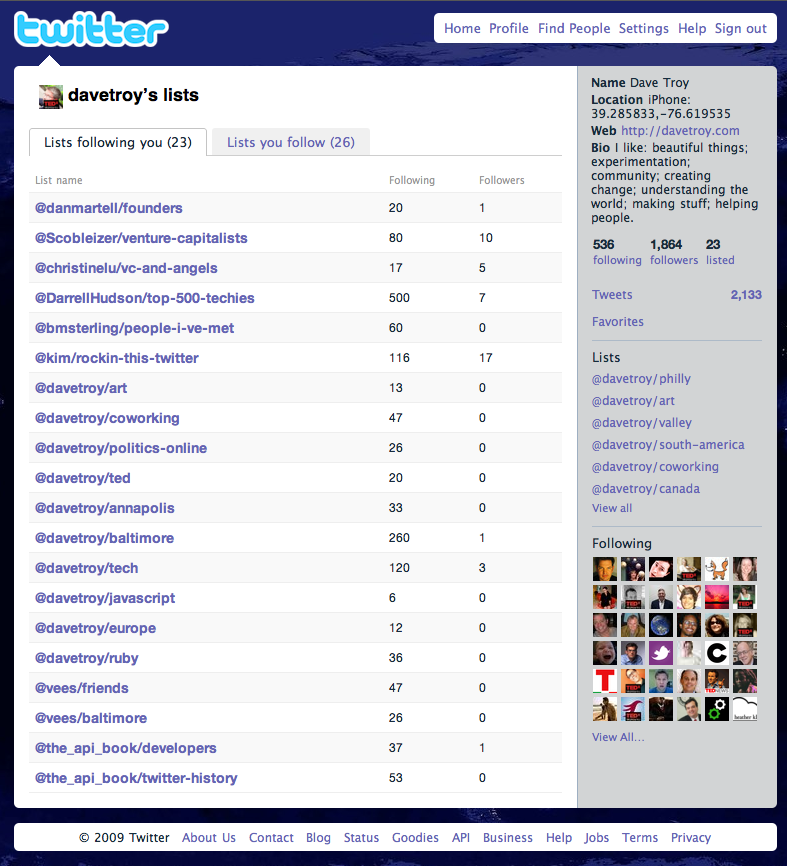
I typically hate writing about topical technology subjects, because most often it’s reactive, worthless speculation.
However, the new Twitter “Lists” feature has me thinking; this is an interesting feature not because of the “tech” but because of the implications on the developing economics of social networks.
First, what it is: Twitter “Lists” allows you to create lists of Twitter users that are stored within Twitter’s servers. You can name those lists (/twitter.com/davetroy/art) and those URL’s can either be public or private.
People can then follow those lists, which really is more like “bookmarking” them, as they do not appear in your Twitter stream. Those lists in turn keep track of how many “followers” they have, and you can see how many people “follow” the lists you create.
Traditional “Follower Economics” Are Dead
Jack Dorsey and Biz Stone always said that the best way to get real value out of Twitter was to follow a small number of people; it was never their intention for people to aim to follow more than 150-200 people (the “Dunbar number,” or people we can realistically expect to maintain relationships with).
With “Lists” you can add someone to a list, but not necessarily “follow” them. So, instead of “following” Ashton Kutcher, you can put him in a list that you call “actors,” or “attention whores.”
You can even put someone in a list (cool people), have them publicize that, and then change the name of that list to something less flattering (douchebags, or worse).
The issue of derogatory lists alone is one that Twitter will need to address.
So traditional “follower counts” are going to be meaningless – instead of “followers” people are going to start talking about “direct followers,” “indirect followers,” and “being listed.” It’s all changing, and I applaud Twitter for being willing to throw the old (flawed) assumptions about follower economics entirely out the window in favor of a new approach.
Buying Influence and Reputation
Within a few hours of the introduction of “Lists” I was put onto a few:
- @danmartell/founders
- @Scobleizer/venture-capitalists
- @christinelu/vc-and-angels
- @DarrellHudson/top-500-techies
- @kim/rockin-this-twitter
- @the_api_book/twitter_history
This early “seed” of my reputation is quite flattering and arguably pretty powerful (though a fraction of what I expect my ultimate “listings” will be). It shows that I am an “investor” and a “techie,” and considered so by some pretty influential people. I did nothing to influence this and would not consider doing so.
But, I am lucky and glad to have been so-described this early on. What if I really wanted to influence what lists I was on, or to appear on as many lists as possible? I can imagine now the jockeying to get onto the lists of all the “A-List” digitalistas will be intense and powerfully ugly.
Imagine the seedy things that might go on at tradeshows in exchange for getting “listed.”
Going forward, the primary question will be which specific lists you appear on (influence of curator, quality, scarcity) and, secondarily, how many lists you appear on (reach, influence).
“1M Followers” will be replaced by “listed by over 50,000,” or even “listed by the top 10 most influential people in microfinance.” And yes, listing counts will be a fraction of follower count, as lists will necessarily divvy up the people you follow through categorization.
Scarcity: You get 20 lists
It looks like people are allowed just twenty lists right now. That’s undoubtedly a scaling and design decision by Twitter to keep things manageable.
Putting aside for a moment all the reasons why people might want more than 20 lists, let’s accept the limitation. You get 20 lists. So it’s a scarce resource. It means Scoble, Kawasaki, Gladwell, Brogan, Alyssa Milano, Oprah, Biz, etc, all each get just 20 lists.
What will someone pay to get onto one of these lists?
Do you think that an author would pay to get onto twitter.com/oprah/incredible-writers? Yeah, I do too. Now imagine that, writ large, and scummier, with people even less reputable than Oprah. Now you see what I’m talking about.
At least buying followers is a scummy behavior that’s amortized over millions of targets; buying 1/20th of one particular follower’s blessing could lead to very high prices and extremely unsavory dealings.
The Coming “Curatorial Economy”
Twitter is doing this thing, and whatever Twitter does in house trumps anything that a third party developer might do, period. So, stuff like WeFollow, etc, your brother’s cool thing he’s making, Twitter directories: they are done, people. Or these external things must at least accept the reality of Lists and what they mean to the ecosystem.
Some folks have been complaining about the user interface for list management, etc, and that’s all moot: it will be available through the API, and you should expect list cloning, lists of lists, mobile client support, etc, pretty soon.
But the genie is out of the bottle. Start managing your reputation in a way that’s authentic and ethical and stay on top of this. And be prepared for what I’m calling the “curatorial economy.” (You heard it here first.)
Everybody’s making collections, and there are certainly people who will pay and be paid for listings. Count on it.
September 29th, 2009 — art, baltimore, business, design, economics, geography, social media
This was originally written as a guest post on Gus Sentementes’ BaltTech blog for the Baltimore Sun.
If you had 5 minutes on stage and 20 slides that rotate automatically every 15 seconds, what would you say? That’s the question that 48 presenters will answer at three upcoming Ignite events in Annapolis, D.C., and Baltimore.
Ignite was started in Seattle in 2006 by Brady Forrest and Bre Pettis, and is overseen by the technology book publisher O’Reilly. Since the founding of the program, hundreds of five minute talks have been given across the world.
The first Ignite event in the area, Ignite Baltimore, was organized in October 2008 by local entrepreneurs Mike Subelsky and Patti Chan and was an immediate success. Held at the Windup Space on North Avenue, the event has attracted standing room only crowds, and the upcoming Ignite Baltimore #4 has been moved to The Walters Art Museum in order to accommodate more people. Ignite Baltimore #4 will take place on Oct. 22. Ignite Baltimore was recently named “Best Geek’s Night Out” by Baltimore Magazine.
This week, the first Ignite Annapolis will be held at Loews Annapolis Hotel in their Powerhouse building. Ignite Annapolis is organized by Kris Valerio (Executive Director of Chesapeake Regional Tech Council, and local actress and theater director) and Jennifer Troy (local entrepreneur) and will take place on Thursday, Oct. 1. The event is sold out, but you may be able to get in if you show up early.
And next week, Ignite DC returns with its second event organized by Jared Goralnick (local entrepreneur and organizer) and Steve Lickteig (radio producer). That event will be held at Town Danceboutique, 2009 8th St NW and should feature several hundred people.
While a handful of well-connected area geeks will likely attend all three events, they are inherently local events designed to connect communities together, and really aren’t all that geeky. Topics span everything from art, history, science, philosophy, and of course, some tech and social media. But Ignite is designed to emphasize that tech has become inherently cross-discipline and is no longer the domain of just infotech nerds. So don’t be surprised when topics roam far and wide.
You can get a taste of Ignite by visiting http://ignite.oreilly.com/show/ and viewing some of the videos available there.
Upcoming Area Ignite Events
• October 1, 6:00pm – Ignite Annapolis, http://igniteannapolis.com
• October 8, 6:00pm – Ignite DC, http://ignite-dc.com
• October 22, 6:00pm – Ignite Baltimore, http://ignitebaltimore.com
Note that all three events are already sold out or close to sold out, so if you have not already registered, space will be very limited. However, you may be able to get in if you show up by 5:00. See the RSVP and waitlist policies for each individual event. And if you can’t make these events, get ready for the next round of Ignites, which will be happening early next year. Ignite Baltimore #5 is planned for the first week of March 2010.
September 29th, 2009 — baltimore, business, design, economics, social media, software, trends
This was originally written as a guest post on Gus Sentementes’ BaltTech blog for the Baltimore Sun.
What if there was a place where freelancers, creatives, entrepreneurs, and financiers could meet up to collaborate on up-and-coming startup ideas? That place exists today, and it’s called Beehive Baltimore.
On October 1st, Beehive Baltimore will celebrate its first nine months of operation as a coworking facility, located in the Emerging Technology Center in Canton.
If you’re not familiar with coworking, it’s a shared workspace for creative professionals who might otherwise work at home or in a coffee shop. These days, anyone who works primarily via laptop and the internet is a great candidate for coworking!
Beehive Baltimore opened February 1, 2009 specifically to cater to these kinds of professionals, and the Beehive community now has over 40 members including people in web design, programming, marketing, public relations, finance and other information-based industries.
Last Thursday, we held an open house at the Hive for prospective members and others in the community to stop by, meet some of our members, and find out more about what coworking is all about.
Beehive is designed to be a community of peers, and does not aim to make a profit. Working in partnership with the Emerging Technology Center in Canton, Beehive aims to connect freelancers, seasoned entrepreneurs, and other professionals via long-term relationships that lead to mutual benefit – and possibly to new startups!
The Hive (as we call it) has also already given birth to multiple events and meet-ups that might not otherwise have a place to meet. Some of the groups that we either have hosted or have helped create include:
- Baltimore Angels (an angel investment group)
- Baltimore Hackers (a computer language study group)
- Baltimore/Washington Javascript meetup
- Baltimore Flash/Flex User Group (a group for users of Adobe’s Flex platform)
- Refresh Baltimore (a web professionals group)
- Barcamp Baltimore (a user-generated tech conference)
- TEDxMidAtlantic (coming on November 5th)
On October 1st at 12pm, Beehive Baltimore will host its first “Show and Tell” event, where participants are invited to share their projects, startups, or prototypes and get feedback from the group.
And on October 15th, Beehive Baltimore will be recognized by the Maryland Daily Record as an “Innovator of the Year.”
Several Beehive members and affiliates will be providing some guest posts for BaltTech over the next two weeks while Gus Sentementes is on vacation. So stay tuned for some voices from the Hive over the coming days!
Beehive Baltimore is part of a large coworking movement. Hundreds of cities all around the world from Los Angeles to Charlotte to Paris to Shanghai have implemented coworking facilities, and we see ourselves as connected to these communities.
And so coworking looks to be an integral part of the tech startup ecosystem – where entrepreneurs, creative talent, and angel investors can all come together to talk about the Next Big Idea.
To find out more about Beehive Baltimore, visit http://beehivebaltimore.org or email info@beehivebaltimore.org.