Entries Tagged 'mobile' ↓
July 9th, 2011 — business, design, economics, mobile, philosophy, software, trends
A lot of people talk about innovation in terms of fulfilling an unmet market need. Specifically, there’s a lot of emphasis on “solving problems.” (I’m looking at you, Dave McClure.) The theory is that entrepreneurs should work on solving a problem that lots of people have, and not get too focused on some technology. That’s fair advice.
However, when entrepreneurs hear this, their first instinct is to often to go ask people about their problems and then try to solve them. Or they look for markets where there is a lot of money being spent.
“The best innovations are those that solve a problem that people didn’t even know that they had,” says Paola Antonelli, curator of design and architecture at MoMA. Twitter certainly falls in this category. In fact most people were sure they didn’t need Twitter, but now it’s a central part of our media landscape.
This class of innovation is the sort you have to shove down people’s throats at first, but then changes the world forever. And they’re tricky to find because no one will tell you they need them. And there’s no market study that outlines the opportunity.
Thinking about this, and stealing some good ideas from design thinking pioneers like Don Norman, Tim Brown, and Daniel Pink, I’ve settled on four key elements that entrepreneurs can use to think about innovation: design, affordances, emergence, and appeal.
Design
Steve Jobs is famously quoted as saying, “design is how it works,” and he’s right. How it works is determined by the design specifications and constraints. If it is software, the major design elements include aspects like synchronous vs. asynchronous, private vs. public, one-to-one vs. one-to-many vs. many-to-many, market size, viral reach, and mode of access. There are many other elements that determine the nature of a product’s design.
The outward aspects – how it looks and feels – are important insofar as they impose an additional set of operational constraints: what’s possible, what’s most likely, how the “happy path” feels, and how brittle the experience is.
When most people think about design, they think about “how it looks.” We’ll get to that in a minute. When you think about design, you really are determining “how it works,” and it’s the most critical part of creating an innovative product.
Affordances
Affordances are the possibilities that a particular design allows. If your product allows for a particular use, then its design affords that possibility. Sometimes there are negative affordances (a part allows for a hinge to open too widely, possibly damaging the product), as well as positive affordances (an iPod Touch can display streaming video, so it afforded the possibility for HBO to make a mobile subscription TV app.)
Every design offers a wide range of affordances, and you should think critically about what they are.
Emergence
Sometimes a design enables new behaviors that its creators did not predict. Users of the product start behaving in a new way that was not anticipated, though it is allowed by the original affordances (say hashtags on Twitter).
Sometimes the emergent behavior is incorporated back into the original design (such as when Twitter adopted hashtags and @ replies, and tracked their trends).
Emergence is usually a happy accident. Biz Stone, co-founder of Twitter, says, “always allow a seat at the table for the unknown.” That is an excellent design goal. By leaving a few doors open, one allows for this kind of emergent behavior to occur, and to capitalize on it.
Designers almost never consider all of the emergent possibilities that their designs afford. Being open to emergence, and incorporating it into later designs, is key to innovation.
Appeal
This is really a subset of design, but it’s worth discussing all by itself. Your product should have curb appeal and create an emotional connection with people that causes them to return to it again and again.
The finest Swiss clockwork will not go anywhere if it is packaged in an ugly shell. While design is “how it works,” your product’s human appeal has everything to do with “how it works with people.” Because without ongoing engagement from people, most products cannot survive.
So, how it “looks” certainly matters, but only insofar as it affects its ongoing appeal, and “how it works with people.” We know the best products are those that create that emotional, nearly-religious connection, and this can’t be overlooked.
Utility Is Difficult to Predict
I think asking about utility is often the worst way to evaluate a design in its early phases. “Why would I use this? What’s it good for? Who needs this?” are questions that are worth contemplating, but it’s also OK if the answer is “I don’t know yet.”
If a design affords a range of emergent behaviors, if it can be distributed to a large group of users, and it can be made appealing and inspire devotion, odds are it’s something worth experimenting with. The odds that the ultimate utility of an interesting design will exceed early predictions is very high.
I love engineers, and do some engineering, but engineers are particularly prone to evaluate concepts in the frame of “how is it different from XYZ that already exists,” or “what technology does it employ?”
The success of the Wii is one of the wins that stymied many engineers. “The graphics sucked, the games were primitive, and there were better technologies on the market.” And those things were not the point. The Wii won because of its design, it affordances, its appeal, and the emergent behaviors (and user communities) it enabled and reached.
So be playful in your designs. Give things a chance. See what happens. Learn from emergent behaviors. And always leave a seat at the table for the unknown.
July 8th, 2011 — design, economics, iPhone, mobile, philosophy, programming, software, trends
Combinatorial Innovation
There are so many new technologies today: tablets, geolocation, video chat, great app frameworks. It is easy to cherry-pick off “combinatorial” innovations that seem compelling, and can maybe even be monetized readily.
But all those innovations are inevitable. If our technologies afford a certain possibility, they will occur. “That’s not a company, that’s a feature,” is one criticism I’ve heard of many “startups.”
These combinatorial, feature-oriented “X for Y” endeavors are often attractive because they can often be built quickly.
Startup Weekend events send an implicit message that a meaningful business can be fleshed out in just a couple of days. And I argue that is not true. That might be a good forum to get practice with building a quick combinatorial technology and working with others, but a real innovation, much less a meaningful business, takes real time.
I think people are often looking in the wrong places for innovation, often because they don’t really take the time to do the homework, observation, and deep reflection necessary to arrive at a true insight. We want things to be quick and easy.
Changing Minds, and Behaviors
The biggest innovations require asking people to change their beliefs, habits, and behaviors.
iPhone: “why would I want a smartphone without a physical keyboard? It’s too expensive. I can’t install apps.”
Twitter: “what is this for? Why would anyone do this? Who cares what I had for breakfast?”
iPad: “an expensive toy. Could never replace a real laptop. Can’t run real office applications. The enterprise will never adopt it.”
Foursquare: “only hipsters and bar hoppers would ever do this. They are letting people know when to rob them. I don’t want people to know where I am.”
And these innovations have taken years of constant attention to bring to their current state. And they are not done.
One Innovator’s Story
Dennis Crowley, founder of Foursquare, was in the room at Wherecamp in 2007 where I was giving a talk about location check-in habits via Twitter (a subject I knew well because of my Twittervision service, which allowed this.)
Dennis, of course, also founded the precursor to Foursquare, Dodgeball, which he sold to Google in 2004 (they promptly killed it.)
But Dennis wanted to see his vision come to pass, and he knew it would someday be possible — though at that point the iPhone had not been released and it would be nearly two years before it supported GPS location technology.
But there Dennis was, doing his homework in 2007, studying user behavior to figure out exactly what behaviors he would have to encourage to make Foursquare work.
He asked me, “so, people are really putting their home and work locations formatted inside tweets in order to update their location?”
“Yep, a few thousand times a day,” I replied.
“That’s cool. That’s really cool stuff,” he said. And from that, and years of similar evidence-gathering and study, Foursquare would be born.
So, creating Foursquare took about five years. (I could have “stolen” the idea and built Foursquare myself. But I didn’t execute on that; it was his vision to pursue.) Dennis did his homework. He was prepared. And his vision preceded the technology that enabled it.
Why, not How
Real innovation doesn’t come from a weekend. It comes from passion, years of study, understanding deep insights and the “why,” and persistence in seeing something new to market, along with the marketing and cheerleading that will make it successful.
The iPad owes much to Steve Jobs’ love of calligraphy. He cultivated a sense of aesthetics because of that initial interest. He didn’t set out to “make money” but rather dedicated himself to changing the world for the better using the entirety of his humanity. Time studying art wasn’t “lost,” it was R&D for the Mac, iPhone, and iPad.
Many of today’s entrepreneurs could stand to do less “hustling” and more reading, exploring, reflecting, and gathering input — and when it is time to make stuff, set their sights as high as possible.
There is more to this world than money, and there are countless opportunities to make it a vastly better place. Rather than using our CPU cycles just playing with combinatorial innovations, let’s devote ourselves to making the world as amazing as possible. Try to take time to reflect on how you can make the world better, and not just on what current technology affords.
November 18th, 2010 — design, mobile, programming, social media, software, trends
Firesheep is a startling plugin that allows anyone to easily impersonate the login credentials of others for dozens of sites. It works on any unencrypted WiFi connection and is stupid-simple to setup. It can be done by anyone in a matter of minutes.
Just to illustrate how easy it is to setup, I was on Virgin America flight VX67 from Washington to San Francisco yesterday.
All I had to do to get going with Firesheep was download Firefox (onto my new MacBook Air) using the in-flight WiFi, and then download the Firesheep plugin for Firefox. Just drag the plugin into Firefox and it installs. Reload Firefox and you’re ready to go.
Click “Start Capturing” and you are instantly snooping on every interaction occurring on the WiFi network. In my case yesterday, that meant snooping on everybody who was using the WiFi on my flight.
What’s At Risk?
Within just a couple of minutes, I was able to impersonate 3 people on Facebook (updating their status, exploring friends, doing anything I wanted to – of course I didn’t). Twitter is also at risk. So is Gmail. And so is Amazon.
Access to Amazon is perhaps the most worrying. Once I realized I was in under someone else’s Amazon account, I quickly shut down Firesheep: this is some scary stuff. What if I had changed the shipping address for the account and done a one-click order on a $10,000 watch or a $2,000 plasma TV?
This was all at 37,000 feet in an airplane (and way more entertaining than SkyMall). Like taking candy from a baby.
Even More Shocking…
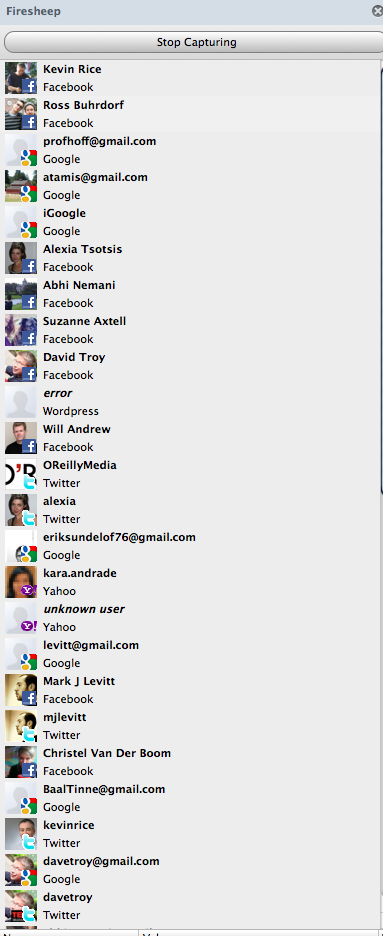
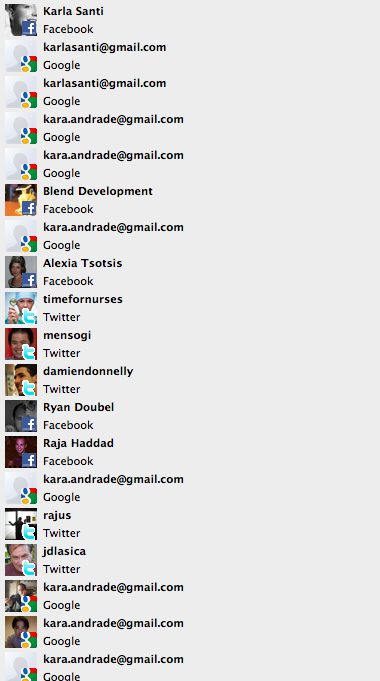
Later in the afternoon I was at one of the Internet Industry’s high-profile events: Web 2.0 Summit produced by O’Reilly. There on the hotel’s WiFi, which was setup to serve the summit, I ran Firesheep. Within seconds I had compromised about 25 accounts, including the Twitter accounts of O’Reilly Media and TechCrunch writer Alexia Tsotsis. Change passwords, tweet-as-them, friend and de-friend people? No problem. Here’s what I saw. (Note that my accounts were vulnerable as well.)
How It Works
I have not studied this exploit carefully enough yet to explain it in full detail, but my understanding is that on an open WiFi network, it’s trivial to capture in cleartext all of the web interactions of the users around you on the same IP network. Once you can do that (something Firesheep achieves using the pcap library, capturing port 80) then you can sniff for credential information specific to particular websites. Firesheep supports a couple of dozen out of the box, including all major social networking sites (Facebook, Twitter, Gmail, Gowalla, Foursquare) but also some more obscure sites relevant to coders (Github, Pivotal Tracker). Ouch. It even has an “import” function so others can write exploits for sites that Firesheep doesn’t know about yet.
The bottom line is that these sites all need to enforce the use of HTTPS (secure HTTP) rather than HTTP *before* the login handshake occurs. This will force some emergency changes by many sites over the next few days.
This is not a new exploit – it’s always been possible to do this; Firesheep just makes it stupid easy.
A Note On Passwords vs. Encryption
You’ve encountered WiFI networks that require WEP or WPA encryption passwords. These are secure from Firesheep’s reach. However, there are a lot of WiFi networks that require “passwords” (such as those at coffee shops, hotels, etc) that are in fact open networks. Many do not even require you to login to them to exploit them via Firesheep. To put it in perspective, every Starbucks location is vulnerable to attack.
The only for-sure ways to stay safe from Firesheep for now are to 1) use only encrypted WiFi networks (that use WPA or equivalent), 2) use wired networks that you trust. Any open WiFi network can and will be vulnerable to this attack until vulnerable sites switch to using HTTPS for all authentication. Be very careful out there, folks.
Update: After talking with a few folks and thinking through this exploit a little further, I can offer a bit more complete of an explanation of how it works and why blocking it is so difficult.
The exploit does not actually capture the *password* itself (which is actually transmitted using HTTPS) but rather captures the authentication credentials which are stored (and visible) in the session cookie *after* HTTPS authentication has completed.
So, even a one-time password will not address this. And the reason boils down to ads and other unsecure content that folks want to serve as part of the site experience. To fix this problem would require serving ads (and images) via HTTPS, which would require major computing resources and will have a major impact on the web.
According to one security researcher I spoke to this evening (who formerly ran Yahoo mail), there’s no obvious way around this other than to allow both HTTP and HTTPS content to be served from the same site during the same session, something which presently causes an alert to the user (which would have the result of freaking them out). Such an alert is a good thing; turning it off is not a net gain. It shouldn’t be up to the user to have to sort out which resources the site is requesting should be secure and which ones do not need to be.
So, it’s a real dilemma. No one seems to be sure how to really address it other than to eliminate or curb the use of open networks, which is probably where it’s going to end up. So open WiFi is now basically over. Expect places that had been using it to post publicly available WPA passwords, which solves the problem.
April 1st, 2010 — business, design, economics, mobile, programming, software, trends
I’m enjoying watching folks around the world prognosticate about the iPad, what it is and is not, how it might sell and what it means for computing. Sorry, but I can’t help but weigh in with some predictions.
My son (age 12) and I have a bet at the moment about the outcome of the NCAA basketball tournament, which I know nothing at all about: I wagered that Duke would emerge victorious (I ignored the rest of the brackets). If I am correct, he owes me $487 trillion dollars; otherwise I owe him $12. (Hey, I’m trying to teach him about Popperian philosophy.)
So, it is with the understanding that if I’m right, you, dear reader will owe me $487 trillion dollars, that I offer this humble marketplace analysis.
- iPad will be released on Saturday, April 3. That means that a ton of people are going to get to play with it over the Easter weekend. And I’m talking about peoples’ moms and aunts here. It’s been widely reported that the experience of using the device is quite seductive, and I’ve argued it’s because it activates different parts of the brain. Somewhere around 200,000 units will be sold over this coming weekend, and each one will be shown to an average of 10.6 other people, creating a latent (nagging) demand for another 21 million units.
- A bunch of old-media outlets will rejigger their offerings for the iPad and try to monetize the audience. Many already have. But this is Waterloo. Or Little Big Horn. They will sucker some folks into using the device for the “traditional” content, but sales will be disappointing. Ultimately they are going to have to radically reconsolidate their offerings and innovate in some serious ways. See below re: piracy.
- The device is going to continue to rip through the population, busting past all sales records for a general computing device. This will have nothing to do with features or even the apps (yet). This will be based on the user experience alone. Everyone who uses the thing comes away sounding like a religious convert. In the same way that the original iPod just “felt right,” Jony Ive has managed to bring meaning to a general purpose computing device like nothing ever before. The central thing Ive has done is to bring the experience of computing directly to the user, with no barriers and no “analog” devices like the mouse. People will have a visceral relationship with these devices.
- Roughly 20% of the initial batch of Wi-Fi only devices will be “handed down” to a secondary wave of users when the 3G models are introduced a month later. This will amplify the initial sales numbers, as many folks end up buying two units in the first month.
- PDF-format books and news will become the Lingua Franca. What happened to music and movies is about to happen to books. A wave of piracy will couple with a race to the bottom in content prices. Some killer app, possibly Kindle for iPad, will capture a big chunk of the market share. It doesn’t much matter how it plays out, but paper books are going to be items of “significance” and the kind of thing hipsters trade, like vinyl records.
- All desktop software will seem obsolete overnight. The obsessive attention Apple has paid to aesthetics in the built-in reader, calendar, and email apps will set the bar not only for other app developers on the iPad, but also for the iPhone and particularly the Desktop. Expect your Mac to feel particularly creaky. And Windows? It’s gonna seem steampunk compared to the twee aesthetics and colors emerging in the iPad design universe.
- WiFi is going to become even more ubiquitous and free. Businesses are going to trip over themselves to get iPad users into their establishments, as the iPad rides its way to prominence. WiFi-only iPads are going to be somewhat cooler than the 3G versions.
- Hipsters are gonna start using iPads as cell phones, using Skype and similar apps to bypass carrier relationships altogether. I’d expect the 3G-iPads to be used for voice too, marking the first significant use of the cellular network in a “data-only” mode, which will ultimately lead to the scrapping of the whole “voice/voicemail/minutes” paradigm. The first carrier to do this will have a temporary competitive advantage.
- A whole new market in mouseless/keyboardless computing will emerge. Yeah, I don’t know what it’s going to look like either. But the raw numbers (100 million by 2015) of the iPad platform will create a new kind of pop/tech culture. Expect a New York Times Sunday magazine piece; potentially in that publications’ last print issue.
- The next generation Macintosh, if there is such a thing, will be based on the iPad OS. Hard to say what this might mean, but I would not be surprised if Mac OS was phased out over a few years, or possibly converted into a server-only OS for the MacPro / X-Serve platform only.
Remember that demand is not static waiting to be filled by the possible universe of devices: if that were the case, the iPod and the Mac and the iPhone should never really have gotten any traffic. What Apple understands is that good design can change the market, and invent new markets.
And this is what the iPad will do: invent a new market. And the presence of that new market will profoundly change the dynamics of the existing (previous) market. New demand will emerge, and all kinds of new supply will emerge. The great thing about Apple, particularly Jobs and Ive, is that they know how to drive change.
And that, ultimately, is what entrepreneurship and innovation are all about. If it were just about building devices to match the demands of the existing market, the Chinese seem to do a pretty good job of that.
And I will supply my banking information, so you can wire me the money, when this all comes to pass. If I’m wrong, I’ll buy you a beer.