It can be difficult to see the forest for the trees when it comes to defining what it is we in the so-called “tech community” are trying to achieve.
The confusion begins with names: some call it the “startup community,” the “tech business community,” or #BmoreTech. Whatever. I’ve been splitting these hairs for several years now, and with the help of many others and after many personal experiences with organizing groups, events, venues, and businesses have developed a simple but powerful vision for the community.
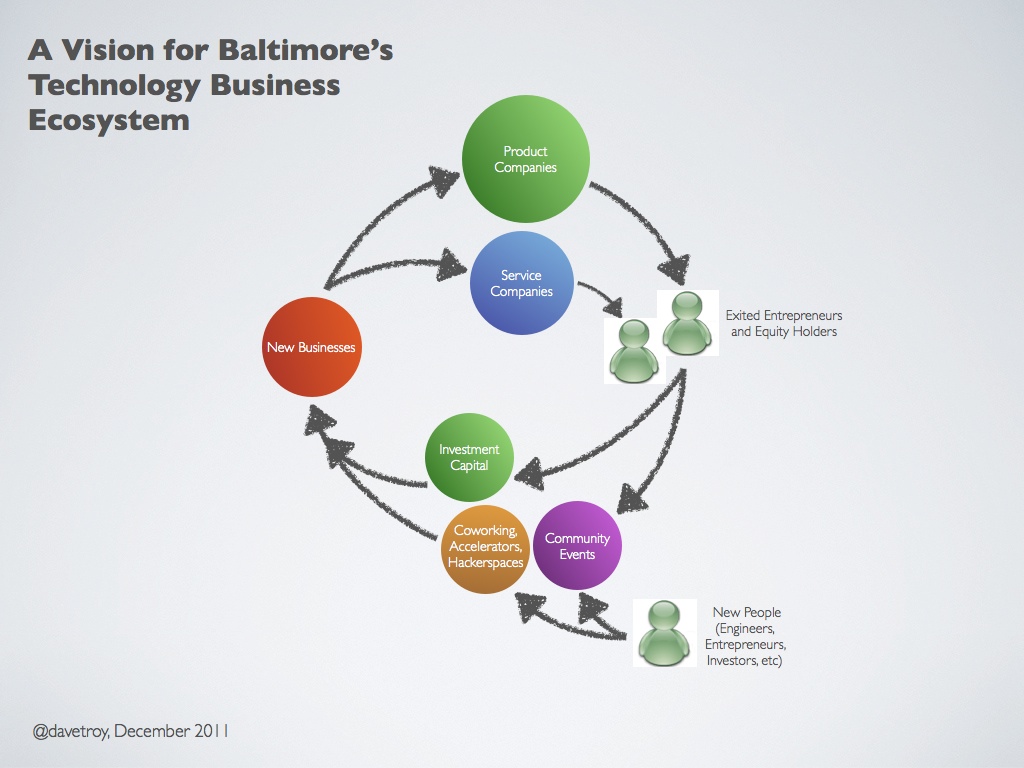
We’re all trying to build an ecosystem that looks something like this (click to enlarge):
Before we get into the specifics of this vision, here are a few basic values that underly it:
People are the lifeblood of the community. The ecosystem requires educated, creative people. We should strive to enrich and build compelling opportunities for the people in our community.
Businesses generate the wealth that powers our community. Strong businesses make a strong community. We should aim to make our businesses stronger and more valuable.
There is a role for everyone. Diversity of expertise and background is essential to a strong business community. We should aspire to have a healthy mix of product companies, service companies, business service providers, and many types of venues and events for relationship building.
We should celebrate our successes. Celebrating successes, whether they are successful exits or just milestones, is essential to creating a community that values growth, curiosity, and experimentation.
We should connect people together. Trust and strong relationships are a precursor to new business formation. With strong trust relationships, we’ll have more new businesses and they will be more successful.
With this in mind, here’s how this model works, step by step. It’s a cycle, and for simplicity, we’ll start at the bottom.
Getting into the mix. (6 o’clock) New participants, exited entrepreneurs, investors, hackers, new entrepreneurs come together via a mix of venues and events. By “venues” I am talking about spaces that offer opportunities for daily, ongoing interaction between individuals. They’re “high touch” while being “low risk.” Think coworking, hackerspaces, regular café coworking, incubators and accelerators, and educational institutions. By “events” I’m talking about one-off or periodic events that afford people an opportunity to get together, get to know one another, and try new things. (Think Bmore On Rails, Startup Weekend, EduHackDay, CreateBaltimore, etc.) New investors can participate in angel groups and pitch events.
New business formation, access to capital. (9 o’clock) With trust, exposure, and experience, new businesses can form. With the prolonged exposure made possible by the “mix” phase, entrepreneurs can make more informed decisions about who to go into business with and have likely had more time to refine their ideas before ever beginning. This means a lower failure rate for new startups than in a less-developed ecosystem. As for investment capital, some will come from exited entrepreneurs, some from venture capitalists, seed funds, and governmental initiatives like TEDCO and InvestMaryland. We should aim to connect investors with nascent businesses. This will happen naturally to some extent in the “mix” phase, but we should consciously encourage it; bootstrapping should also be an option.
Business growth. (12 o’clock) Some companies will grow to become strong product companies, others will become service companies. Some people want to grow their businesses to sell them, while others just want to build and run a great business. These approaches are all valid. We should celebrate the formation and growth of all of the companies in our ecosystem.
Entrepreneur exits. (3 o’clock) Some entrepreneurs will seek the opportunity to exit their businesses and capitalize on their growth. This is most lucrative with product companies. When these exits occur, we should celebrate them as successes of the community as a whole.
Entrepreneur returns to the mix. (6 o’clock) Exited entrepreneurs should be encouraged to re-engage with the community, either as investors or as active entrepreneurs to form new relationships and new businesses. The cycle starts anew.
That’s really it. If we can make this cycle work, we’ll have a thriving entrepreneurial ecosystem in Baltimore. (This is the exact same cycle that made Silicon Valley great, and is now working in places like Boston, Austin, and New York.)
That’s Great, But Where Do We Stand Now?
We have much of what we need in place: venues, events, investors, and businesses. But the two things we have most lacked are a cohesive vision for how this cycle is supposed to work, and also the last link in the cycle – systematically re-engaging entrepreneurs into the ecosystem.
However, just today came the news that Greg Cangialosi and Sean Lane are forming a startup accelerator in Federal Hill. That’s an example of two successful entrepreneurs getting back into the mix and re-engaging. We need more of that. But we need to make it easier and more attractive for entrepreneurs – there need to be obvious on-ramps and channels. We’re starting to get that in place.
My hope is that this vision, which I have shared in one-on-one conversations with many friends and leaders to much enthusiastic agreement, can now take root as the underlying force that animates our community.
Role of the Greater Baltimore Technology Council
There’s been much discussion about what the role of the Greater Baltimore Technology Council should be, and I submit that this vision, as I’ve articulated it here, is what the group has been moving toward for the last three years – and with Jason Hardebeck (who is himself an exited entrepreneur) at the helm, I believe we can move towards it more quickly now.
The GBTC’s job is to:
Help build and protect the ecosystem. GBTC should be a watchdog that ensures the ecosystem has the right pieces in place and that they have what they need to function properly. This means working with government, educational institutions, and others to ensure that the conditions required for the ecosystem to thrive are present.
Accelerate the cycle. The faster this ecosystem operates, the more successful we will be. Specifically, GBTC should connect people together, and celebrate our collective achievements, and help pull our educational institutions into the ecosystem. Ultimately this will pull in more smart, creative people, accelerating the cycle further.
Make our businesses stronger. By connecting our community together better and providing venues, events, connections, and celebrating our success stories, GBTC can help to make each of our businesses stronger and more robust. This also means connecting businesses to service providers (HR, insurance, accounting, legal) and mentors who can provide value.
For all the drama and hand-wringing, it really is this simple!
Some have wondered whether they “belong” in the GBTC. That’s something every person and entrepreneur has to decide for themselves; there are obviously many valid and valuable ways to participate in this overall vision that are outside of the scope of the GBTC. However, if you care about growing and protecting this ecosystem, and if the group can help your business grow and succeed, I’d encourage you to lend GBTC your support; it just makes good business sense, as GBTC is the only group that has been tasked with this important work.
I know that others in positions of leadership in Baltimore’s tech business community (and at GBTC) share this vision. I encourage your comments and feedback, but before reacting, you might take some time to really think this over. This is something I’ve been looking at for several years, and based on everything I know, this is the right way forward.
The Rest of the Story
Oh, and there’s one more thing.
We all want to prime this pump and get this vision more fully underway, but I also think it’s reasonable to ask how Baltimore’s tech ecosystem fits into the bigger scheme of things. What relationship should we have with other ecosystems, in our region and around the world? Is the point to win or are we trying to thrive? I’ll be touching on this topic in an upcoming post, and it should help to clarify how this vision makes even more sense for Baltimore.
I’ve been vocal about the 2011 Mayoral Race in Baltimore. It’s an opportunity to break free of the machine and finally put the city first.
But there’s a sorry timidity in Baltimore politics. Everyone agrees we need change. But too many are resigned to the way things have been, and whose “turn” it is. Who owes who favors. But this is a democracy, you say. Every vote counts, right?
That’s not how things have been. In Baltimore, the fix has always been in. However, last year we started to see the machine creak. Upstart young candidate Bill Ferguson unseated 27-year incumbent George Della. Gregg Bernstein defeated long-time incumbent Pat Jessamy. Cynics would point out that Ferguson was adopted by a clique of developers, or that Jessamy ran a horrible, entitled campaign. But still, this wasn’t how it was supposed to be.
There is other evidence of the decline and fall of the system. Ridiculous and incompetent Belinda Conaway filed a $21M suit against a blogger – which backfired. Now her challenger Nick Mosby has a real shot at upending the ludicrous and long-time Conaway “three bears” platform. And her father Frank appears more ridiculous every day.
I want more for Baltimore. That’s why I’ve supported Otis Rolley in his campaign for mayor. I’m simply tired of business-as-usual in Baltimore.
Specifically, I’m tired of developers being offered tax breaks in exchange for campaign contributions. I’m tired of city contractors being given lucrative no-bid contracts in exchange for campaign contributions. I’m tired of the same old tribe of corrupt, cynical power brokers doing what they have always done.
A vote for Otis is a vote for new blood – and for entirely different people. Don’t kid yourself. When you vote, you’re not voting for policies or a platform. You’re voting for a power structure. You’re voting for a group of people.
Stephanie’s people: out-of-state contractors, developers, city contractors, democratic party operatives, county-based people with interests in the city, friends of her father’s, the Governor, the Governor’s brother, attorneys, KAGRO (the trade group that represents the Korean corner-grocers profiting from Baltimore’s food deserts), casino operators, scrap metal dealers, city employees. These people have either “paid to play” or are actively benefiting from the decline, fall, and eventual ruin of Baltimore – or want to have a finger on exactly how Baltimore is run.
Otis Rolley’s people: real citizens of Baltimore (rich and poor; more individual donations than any other candidate); tech people, urban farming people, entrepreneurs, designers, patrons of the arts, folks from ALL of Baltimore’s neighborhoods.
Catherine Pugh’s people: contacts from her work in Annapolis, aerospace contractors (?), some decent and concerned folks throughout Baltimore, a computer repair shop on Fayette street, Scott Donahoo (used car dealer).
Jody Landers’ people: folks primarily concerned with the property tax issue, strong base in NE Baltimore, realtors, and many individuals associated with real-estate issues and encouraging residency in the city. (Ed. note: this post previously made reference to Live Baltimore, on whose board of directors I serve. There was no intention to associate Live Baltimore with any candidate or agenda.) Not many others.
I like and respect Jody Landers and Catherine Pugh. However, I had hoped that Jody would weigh his chances, drop out of the race, and back Otis. I, and others, asked him to do just that. And I think Catherine Pugh can do more for Baltimore by continuing to serve as a State Senator in Annapolis. She had nothing to lose by running for Mayor.
The conventional wisdom (The Sun, with its one poll and its feeble, lackluster endorsement of Rawlings-Blake) says that the fix is in, and we should just accept our fate.
There is one way that this race can end differently, and that is to turn out votes for Otis Rolley tomorrow.
The same set of jaded old political pundits (Barry Rascovar, Frasier Smith, Matthew Crenson – I’m looking at you) who will tell you that the “race is in the bag” for Stephanie are the same ones who also predict that turnout will be atrociously low on Tuesday.
Wonder why that would be? Maybe folks are tired of being told how to vote, and that races are over before they start.
It’s true. The internet and social media are not the drivers of voting behavior in Baltimore yet. But the Ferguson, Bernstein, Mosby, Ramos, and Rolley candidacies have received a boost from discussion by “networked citizens” that is unprecedented in Baltimore. And that’s something that the Sun’s lone pollster and our 1980’s era political pundits seem incapable of understanding. And the sentiment on Twitter has been overwhelmingly in favor of Otis Rolley (with almost no mention of Sen. Pugh, and few positive comments for the Mayor.)
It’s impossible to predict the outcome of tomorrow’s race. But know this: YOU can change it. You have a voice. Go vote. Get others to vote. Baltimore deserves that.
And beyond tomorrow, there’s another truth: 5th most violent, the 6th dirtiest and the 7th most murderous is no longer good enough for Baltimore.
To all those who say “stay the course,” please get out of the way. Baltimore deserves the best. We’re done waiting.
Check out Tom Loveland’s insider view of this election (and accompanying post). The reality will surprise you.
Otis Rolley delivers this powerful “closing argument” on why you should choose him as your next Mayor.
Otis shows his deep love for Baltimore, and understanding of cities, at TEDxMidAtlantic 2010.
A lot of people talk about innovation in terms of fulfilling an unmet market need. Specifically, there’s a lot of emphasis on “solving problems.” (I’m looking at you, Dave McClure.) The theory is that entrepreneurs should work on solving a problem that lots of people have, and not get too focused on some technology. That’s fair advice.
However, when entrepreneurs hear this, their first instinct is to often to go ask people about their problems and then try to solve them. Or they look for markets where there is a lot of money being spent.
“The best innovations are those that solve a problem that people didn’t even know that they had,” says Paola Antonelli, curator of design and architecture at MoMA. Twitter certainly falls in this category. In fact most people were sure they didn’t need Twitter, but now it’s a central part of our media landscape.
This class of innovation is the sort you have to shove down people’s throats at first, but then changes the world forever. And they’re tricky to find because no one will tell you they need them. And there’s no market study that outlines the opportunity.
Thinking about this, and stealing some good ideas from design thinking pioneers like Don Norman, Tim Brown, and Daniel Pink, I’ve settled on four key elements that entrepreneurs can use to think about innovation: design, affordances, emergence, and appeal.
Design
Steve Jobs is famously quoted as saying, “design is how it works,” and he’s right. How it works is determined by the design specifications and constraints. If it is software, the major design elements include aspects like synchronous vs. asynchronous, private vs. public, one-to-one vs. one-to-many vs. many-to-many, market size, viral reach, and mode of access. There are many other elements that determine the nature of a product’s design.
The outward aspects – how it looks and feels – are important insofar as they impose an additional set of operational constraints: what’s possible, what’s most likely, how the “happy path” feels, and how brittle the experience is.
When most people think about design, they think about “how it looks.” We’ll get to that in a minute. When you think about design, you really are determining “how it works,” and it’s the most critical part of creating an innovative product.
Affordances
Affordances are the possibilities that a particular design allows. If your product allows for a particular use, then its design affords that possibility. Sometimes there are negative affordances (a part allows for a hinge to open too widely, possibly damaging the product), as well as positive affordances (an iPod Touch can display streaming video, so it afforded the possibility for HBO to make a mobile subscription TV app.)
Every design offers a wide range of affordances, and you should think critically about what they are.
Emergence
Sometimes a design enables new behaviors that its creators did not predict. Users of the product start behaving in a new way that was not anticipated, though it is allowed by the original affordances (say hashtags on Twitter).
Sometimes the emergent behavior is incorporated back into the original design (such as when Twitter adopted hashtags and @ replies, and tracked their trends).
Emergence is usually a happy accident. Biz Stone, co-founder of Twitter, says, “always allow a seat at the table for the unknown.” That is an excellent design goal. By leaving a few doors open, one allows for this kind of emergent behavior to occur, and to capitalize on it.
Designers almost never consider all of the emergent possibilities that their designs afford. Being open to emergence, and incorporating it into later designs, is key to innovation.
Appeal
This is really a subset of design, but it’s worth discussing all by itself. Your product should have curb appeal and create an emotional connection with people that causes them to return to it again and again.
The finest Swiss clockwork will not go anywhere if it is packaged in an ugly shell. While design is “how it works,” your product’s human appeal has everything to do with “how it works with people.” Because without ongoing engagement from people, most products cannot survive.
So, how it “looks” certainly matters, but only insofar as it affects its ongoing appeal, and “how it works with people.” We know the best products are those that create that emotional, nearly-religious connection, and this can’t be overlooked.
Utility Is Difficult to Predict
I think asking about utility is often the worst way to evaluate a design in its early phases. “Why would I use this? What’s it good for? Who needs this?” are questions that are worth contemplating, but it’s also OK if the answer is “I don’t know yet.”
If a design affords a range of emergent behaviors, if it can be distributed to a large group of users, and it can be made appealing and inspire devotion, odds are it’s something worth experimenting with. The odds that the ultimate utility of an interesting design will exceed early predictions is very high.
I love engineers, and do some engineering, but engineers are particularly prone to evaluate concepts in the frame of “how is it different from XYZ that already exists,” or “what technology does it employ?”
The success of the Wii is one of the wins that stymied many engineers. “The graphics sucked, the games were primitive, and there were better technologies on the market.” And those things were not the point. The Wii won because of its design, it affordances, its appeal, and the emergent behaviors (and user communities) it enabled and reached.
So be playful in your designs. Give things a chance. See what happens. Learn from emergent behaviors. And always leave a seat at the table for the unknown.
There are so many new technologies today: tablets, geolocation, video chat, great app frameworks. It is easy to cherry-pick off “combinatorial” innovations that seem compelling, and can maybe even be monetized readily.
But all those innovations are inevitable. If our technologies afford a certain possibility, they will occur. “That’s not a company, that’s a feature,” is one criticism I’ve heard of many “startups.”
These combinatorial, feature-oriented “X for Y” endeavors are often attractive because they can often be built quickly.
Startup Weekend events send an implicit message that a meaningful business can be fleshed out in just a couple of days. And I argue that is not true. That might be a good forum to get practice with building a quick combinatorial technology and working with others, but a real innovation, much less a meaningful business, takes real time.
I think people are often looking in the wrong places for innovation, often because they don’t really take the time to do the homework, observation, and deep reflection necessary to arrive at a true insight. We want things to be quick and easy.
Changing Minds, and Behaviors
The biggest innovations require asking people to change their beliefs, habits, and behaviors.
iPhone: “why would I want a smartphone without a physical keyboard? It’s too expensive. I can’t install apps.”
Twitter: “what is this for? Why would anyone do this? Who cares what I had for breakfast?”
iPad: “an expensive toy. Could never replace a real laptop. Can’t run real office applications. The enterprise will never adopt it.”
Foursquare: “only hipsters and bar hoppers would ever do this. They are letting people know when to rob them. I don’t want people to know where I am.”
And these innovations have taken years of constant attention to bring to their current state. And they are not done.
One Innovator’s Story
Dennis Crowley, founder of Foursquare, was in the room at Wherecamp in 2007 where I was giving a talk about location check-in habits via Twitter (a subject I knew well because of my Twittervision service, which allowed this.)
Dennis, of course, also founded the precursor to Foursquare, Dodgeball, which he sold to Google in 2004 (they promptly killed it.)
But Dennis wanted to see his vision come to pass, and he knew it would someday be possible — though at that point the iPhone had not been released and it would be nearly two years before it supported GPS location technology.
But there Dennis was, doing his homework in 2007, studying user behavior to figure out exactly what behaviors he would have to encourage to make Foursquare work.
He asked me, “so, people are really putting their home and work locations formatted inside tweets in order to update their location?”
“Yep, a few thousand times a day,” I replied.
“That’s cool. That’s really cool stuff,” he said. And from that, and years of similar evidence-gathering and study, Foursquare would be born.
So, creating Foursquare took about five years. (I could have “stolen” the idea and built Foursquare myself. But I didn’t execute on that; it was his vision to pursue.) Dennis did his homework. He was prepared. And his vision preceded the technology that enabled it.
Why, not How
Real innovation doesn’t come from a weekend. It comes from passion, years of study, understanding deep insights and the “why,” and persistence in seeing something new to market, along with the marketing and cheerleading that will make it successful.
The iPad owes much to Steve Jobs’ love of calligraphy. He cultivated a sense of aesthetics because of that initial interest. He didn’t set out to “make money” but rather dedicated himself to changing the world for the better using the entirety of his humanity. Time studying art wasn’t “lost,” it was R&D for the Mac, iPhone, and iPad.
Many of today’s entrepreneurs could stand to do less “hustling” and more reading, exploring, reflecting, and gathering input — and when it is time to make stuff, set their sights as high as possible.
There is more to this world than money, and there are countless opportunities to make it a vastly better place. Rather than using our CPU cycles just playing with combinatorial innovations, let’s devote ourselves to making the world as amazing as possible. Try to take time to reflect on how you can make the world better, and not just on what current technology affords.
I am CEO and co-founder at 410Labs, and creator of Mailstrom. I'm a serial entrepreneur, software developer, and community builder in Baltimore, Maryland, USA.