December 4th, 2013 — baltimore, economics, geography, politics, trends
For Baltimore City to grow and prosper once again, several problems must be solved: jobs, crime, and education are chief among them. But these are mere symptoms of the decades of systematic disinvestment which has characterized much of urban America since 1960.
A return to prosperity is possible, and we’ve seen it happen in other American cities like Washington, DC and New York City. But this didn’t happen by accident. It happened through a combination of strong political leadership and outside and local investment.
It happened by creating a level playing field, and creating a fair, open, and equitable business climate that attracted outside investment. It happened by creating city governments that were open and accountable and in which citizens have some confidence.
In cities like Boston and San Francisco, it happened thanks to the lowering of property tax rates across the board, spurring not just Big Developer projects but investment by individual homeowners.
But in Baltimore, we have two distinct problems. One is qualitative: we can’t be trusted. The other is quantitative: we need to fix property taxes.
Baltimore is just not trustworthy. No one trusts Baltimore City government. Outside investors see the city as a parochial, pay-to-play backwater where insiders call the shots. Commercial developers correctly believe that you need to make significant investment in laying groundwork with specific politicians, developers, and contractors to get a project started here.
Prospective residential buyers perceive Baltimore City government as bloated, inefficient, outdated, resistant to change, and focused more on working out deals with insider developers than on creating a solid residential base. And they have good reason to harbor this perception. While there are many good and dedicated people in city government who care deeply about residents and residential issues, the inefficiency and waste are undeniable. And they are everyday reality for city residents — many of whom share their horror stories with their friends and neighbors.
Many Baltimore City agencies have not been audited in decades. The audit of the Department of Recreation and Parks is now almost one year overdue — primarily because of lack of sufficient financial records. Baltimore City is preparing to return $7M to the federal government because it was unable to account for how Baltimore’s Homeless Services department spent any of those funds.
This is inexcusable. In any other setting, if money goes missing, heads roll. But the machine grinds on here with no firings, no outrage, just talking around the facts and playing down the mistakes. It’s no wonder no one trusts Baltimore City government, for it has proven itself not only untrustworthy but systemically incapable of correcting the problem.
Yes, we need to restructure property taxes. Boston and San Francisco both flourished after making changes to their property taxes. Every city is unique, and their fortunes were rising in many ways regardless. Our star is rising too. We are an incredibly well-located city in the richest state in the union. The future is bright — and we can accelerate our fortune dramatically.
Before we worry over fixing property taxes (a quantitative problem), let’s first prove that we’re capable of earning and actually worthy of people’s trust once again (a qualitative problem).
Let’s show that we care about financial accountability by rooting out waste, fraud, abuse, and inefficiency in every corner of Baltimore government. Let’s show we’re serious by pledging to:
- Perform annual audits of every city agency
- Discipline and fire people who oversee waste and abuse
- Prosecute cases of fraud, graft, and malfeasance
- Level the playing field for outside investors (both commercial and residential)
- Get serious about eliminating inefficiency and waste
- Open as much of the city’s records and data as possible
- Cultivate the perception that Baltimore government is fair, honest, open, and efficient
Mayor Stephanie Rawlings Blake is a smart, capable, and honest leader who has become entrenched in the culture of business-as-usual here in Baltimore — which simply must change. We need to call on the Mayor to lead this charge and demand accountability from all of the departments she oversees.
This isn’t going away. The next step in Baltimore’s return to prominence is to become — and be perceived as — a trusted and honest partner. Sweeping problems under the rug won’t get us there.
Instead, it’s time to start throwing some people — the people who allow waste, fraud, and abuse — under the bus. Comprehensive financial and performance audits of city government are the best way to begin.
November 25th, 2012 — geography, politics, trends, visualization
I wrote recently about population density and its relationship to voting behaviors. In the 2012 election, high population density correlated with votes for Obama, while low density correlated with votes for Romney.
Others observed that red states have more traffic fatalities than blue states. This is fairly easy to explain, as red states are lower density than blue states and people necessarily spend more time in cars than in the cities of blue states.
Some suggested that race is more important and proposed some version of “white people vote for white people, black people vote for black people” as the simpler explanation. But this notion has always struck me as simplistic.
So I decided to dig in to voting behaviors by examining racial composition and the 2012 election results at the county level.
(click to enlarge)
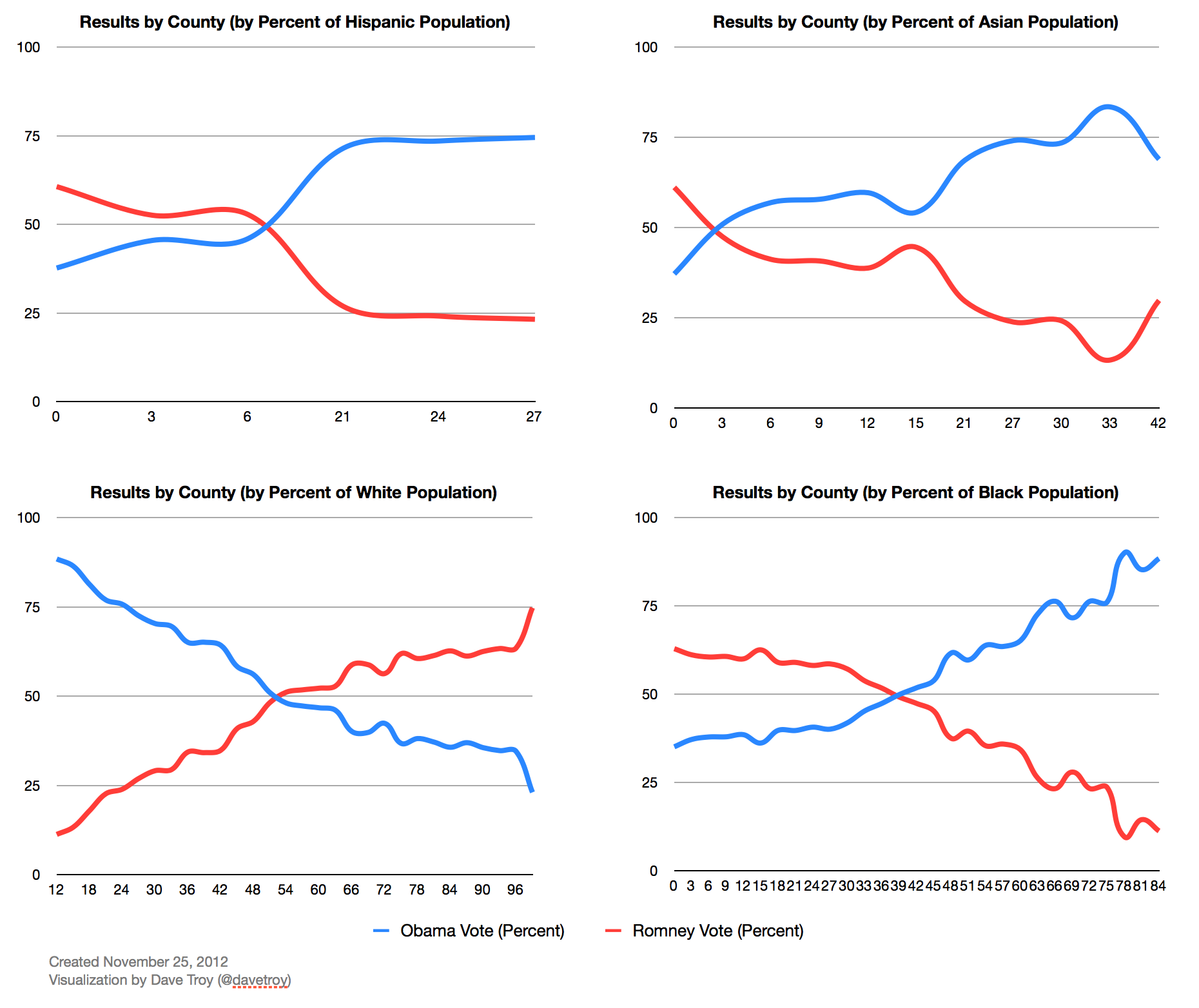
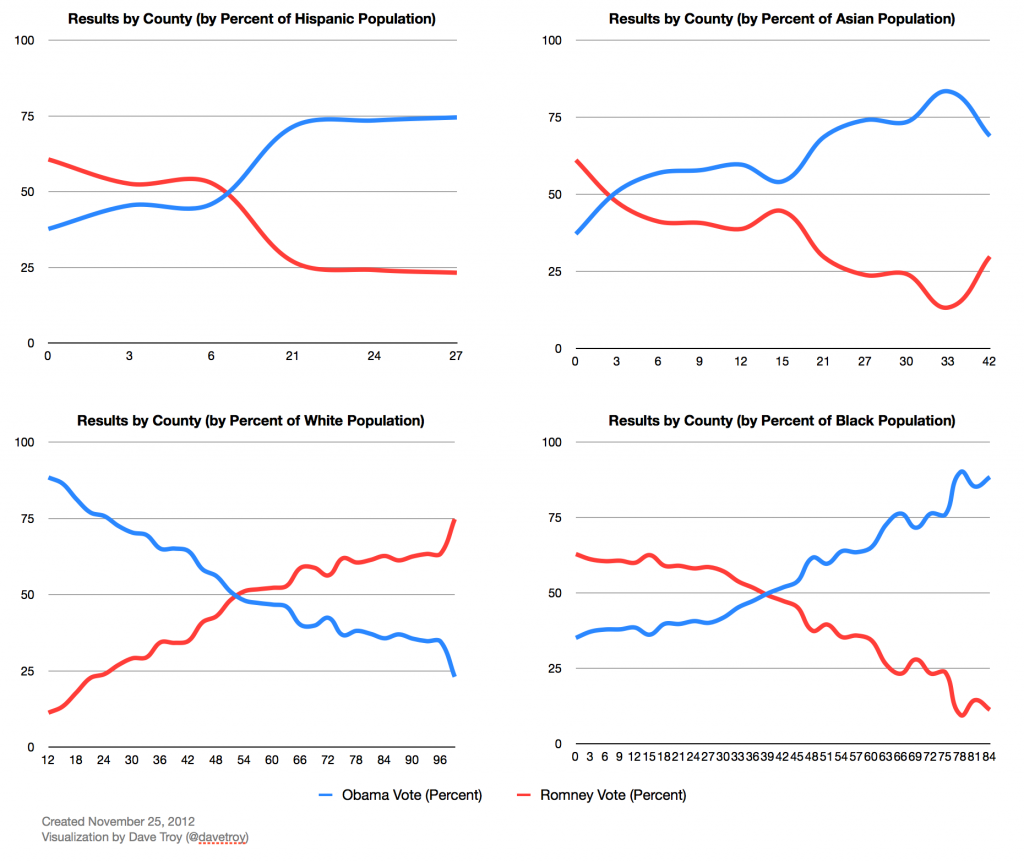
Any significant level of diversity seems to trigger liberal voting behavior. At 9% Hispanic population (or just 3% Asian population), people vote blue. Think about that for a second… if your county has just a 3% Asian population, it most likely voted Democratic.
So Do People Vote by Race?
The data show that when the percentage of black population exceeds 39%, Obama receives the bulk of the votes. This would indicate that yes, black people do often vote for black people, which by itself is not that informative. But Asians and Hispanics also apparently vote for black people as well.
Above about 55% white population, counties overwhelmingly voted for Romney. But up to 45% white population, votes went to Obama.
The real drivers seem to be density and diversity. Density (such as found in cities) corresponds with diversity. Diversity leads to progressive voting behavior.
Identity Politics
It’s simplistic to think that it’s all about identity. White voters didn’t all vote for Romney, black voters didn’t all vote for Obama, and Hispanic and Asian candidates overwhelmingly supported Obama. There is no particular reason to think that an Hispanic Republican candidate can win by running on the same old platform.
To succeed, both parties need to run candidates that will appeal to the population in America’s increasingly diverse and dense cities.
November 24th, 2012 — geography, politics, trends, visualization
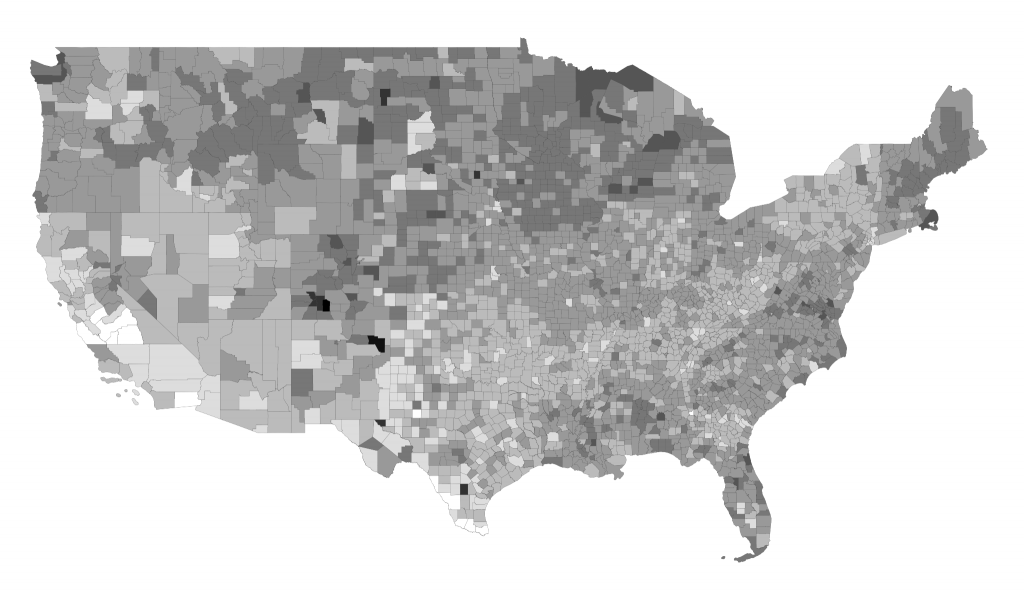
I’ll be writing more about the correlation between population density and voting behaviors, but in the meantime check out these maps showing participation in the 2012 election. (Darker areas voted more than lighter areas.)
So the country voted. Some parts more than others.
What I think is interesting is that much of middle America, particularly in the middle-south, didn’t vote as heavily as people in the north. (The Appalachia/Ozarks belt viagrasstore.net?) California’s central valley also voted pretty lightly.
A few places turned out in BIG numbers (85-90%). Hard to say what might be going on there, but in general I’d say those people are the most annoyed and felt like they needed to vote.
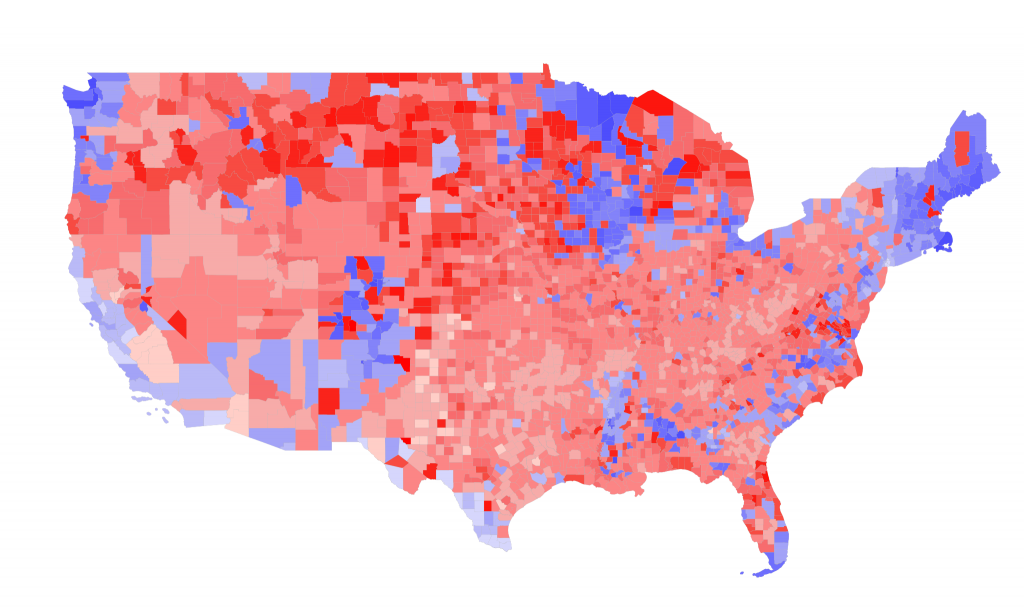
The above map shows turnout by county (indicated by shade); the winner is indicated by color (Red Romney, Blue Obama).
Map created by David Troy using Ruby, Quantum GIS and TileMill. Data sources: Politico Election Results by County, US Census Tiger Shapefiles. May be reproduced with attribution.
November 19th, 2012 — design, economics, geography, politics, trends, visualization
The 2012 election demonstrated what many people could have guessed: rural states voted for Romney while densely populated states voted for Obama.
Many have offered explanations — everything from the presence of top universities in cities, to the prevalence of immigrant and African American populations. Perhaps the Republicans should consider running a Hispanic or African American candidate in 2016; but will that really help? Is identity the issue, or is it more about values?
Or is something more basic at work? Studying election results county by county, a stunning pattern emerges.
Population Density: the Key to Voting Behavior?
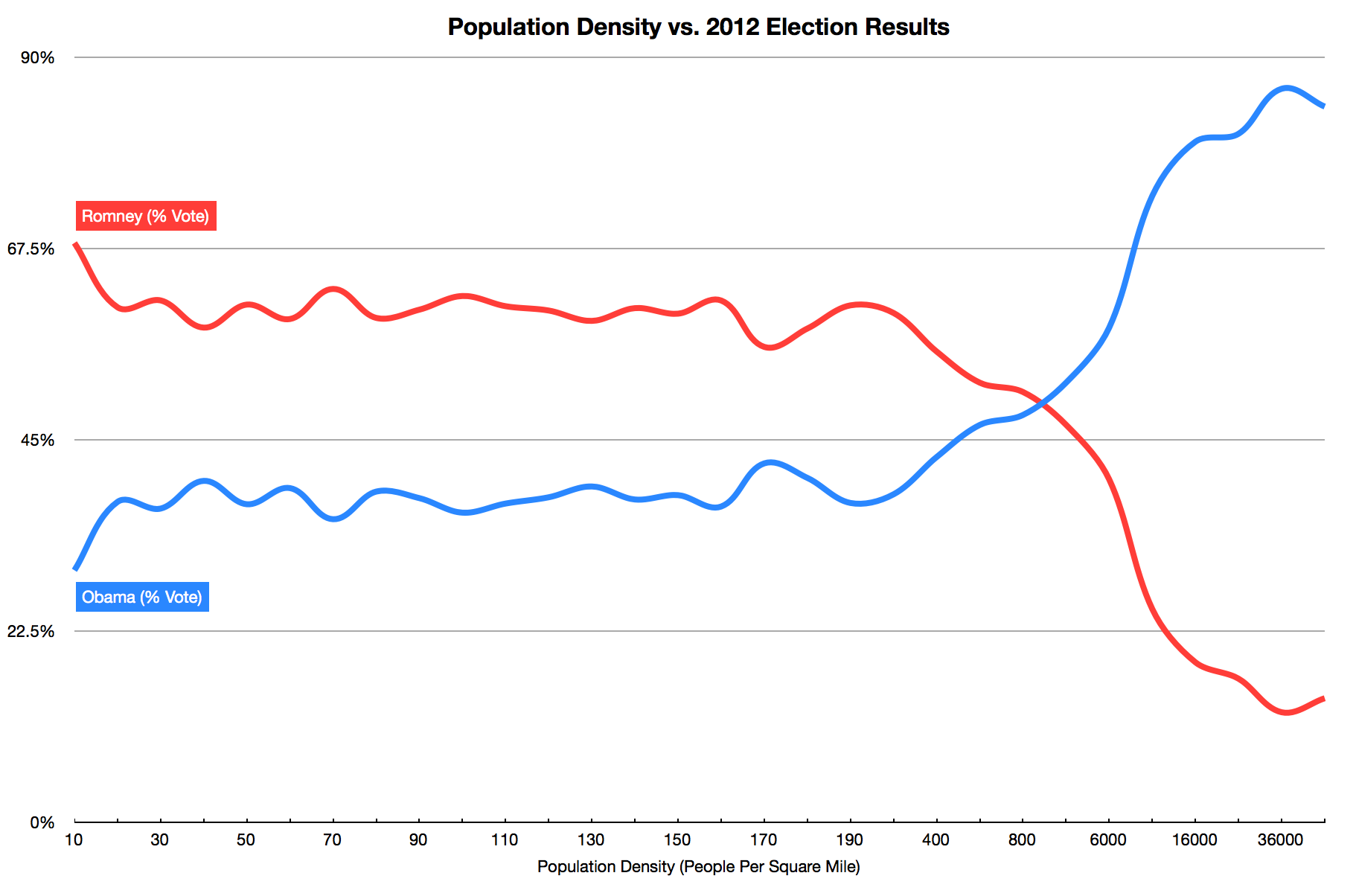
Curious about the correlation between population density and voting behavior, I began with analyzing the election results from the least and most dense counties and county equivalents. 98% of the 50 most dense counties voted Obama. 98% of the 50 least dense counties voted for Romney.
This could not be a coincidence. Furthermore, if the most dense places voted overwhelmingly for Obama, and the least dense places voted overwhelmingly for Romney, then there must be a crossover point: a population density above which Americans would switch from voting Republican to voting Democratic.
So I normalized and graphed the data, and there is a clear crossover point.
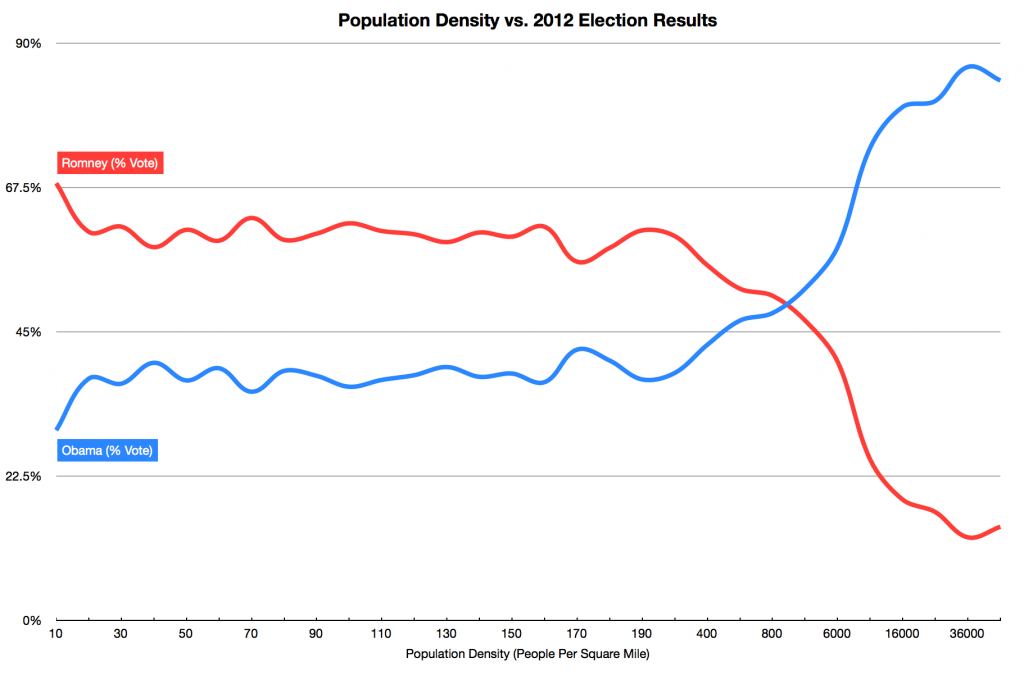
At about 800 people per square mile, people switch from voting primarily Republican to voting primarily Democratic. Put another way, below 800 people per square mile, there is a 66% chance that you voted Republican. Above 800 people per square mile, there is a 66% chance that you voted Democrat. A 66% preference is a clear, dominant majority.
So are progressive political attitudes a function of population density? And does the trend hold true in both red and blue states?
Red States and Blue States
Separating the results from red states and blue states, we can see that while each has a slight preference for their ultimate candidate of choice, on a local level voting behavior is still directly correlated to population density.
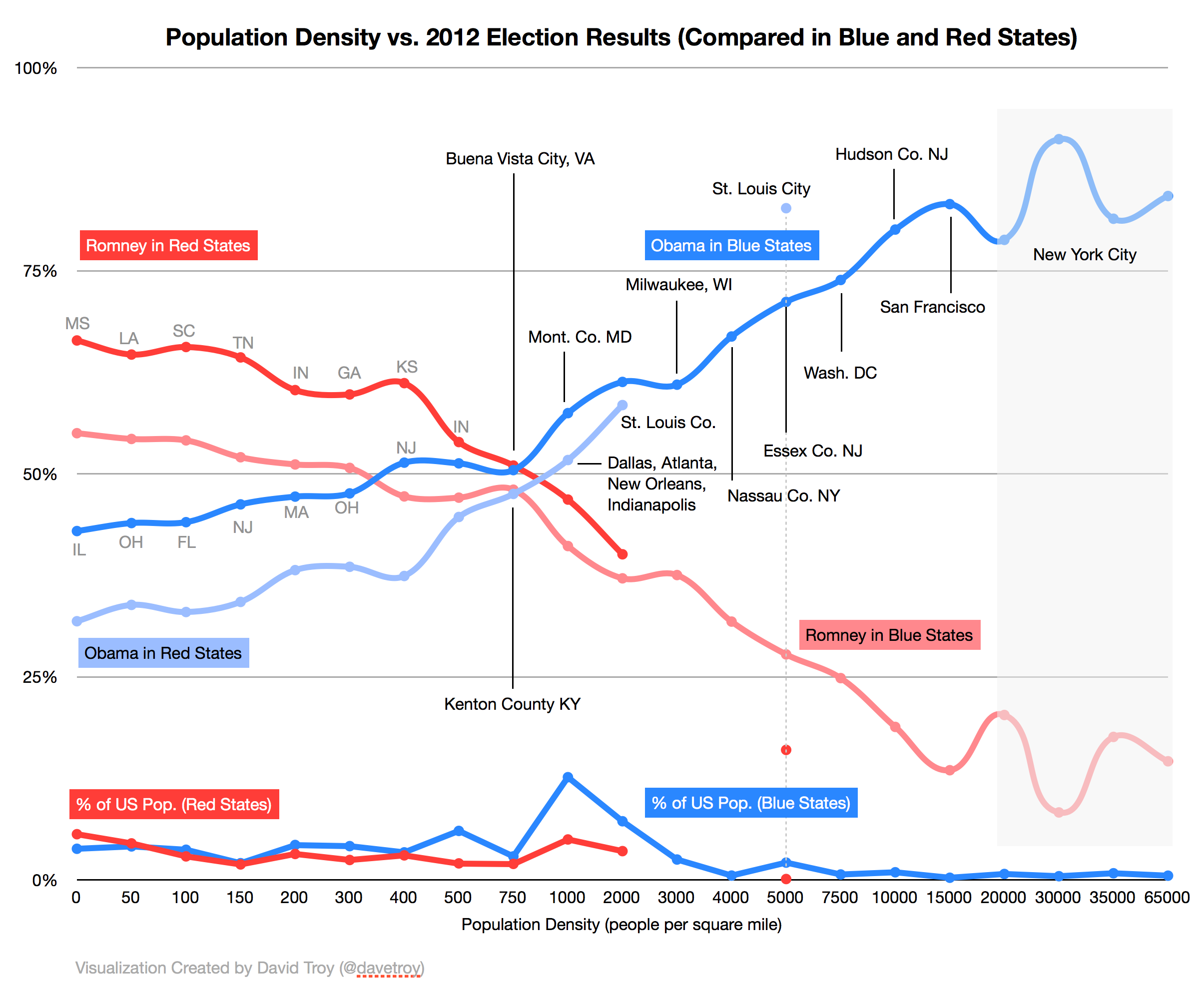
Studying this graph, two important facts are revealed. First, there are very few cities in red states. Second, the few dense cities that do exist in red states voted overwhelmingly democratic.
Atlanta, New Orleans, St. Louis, Dallas, and Indianapolis are all in red states — and they all voted blue. And there are no true “cities” in red states that voted red. The only cities in red states that didn’t vote blue were Salt Lake City and Oklahoma City. And by global standards, they are not really cities — each has population density (about 1,000/sq. mi.) less than suburban Maryland (about 1,500/sq. mi.).
Historically, one can argue that red states have disproportionately affected election results by delivering a material number of electoral votes.
Red states simply run out of population at about 2,000 people per square mile. St. Louis is the only city that exceeds that density in a red state. It voted overwhelmingly Democratic (82.7%). In contrast, blue states contain all of the country’s biggest and densest cities: Washington DC, New York City, San Francisco, Baltimore, Milwaukee, Philadelphia, Boston, etc.
Red States Are Just Underdeveloped Blue States
As cities continue to grow in red states, those cities will become more blue, and ultimately, those states will become more purple, and then blue. The Republican party says it’s about growth and prosperity; the best way to achieve that in red states is through the growth of cities.
If you follow the red state trend lines, you can clearly see that any dense, fast-growing cities that might emerge in red states will be very likely to vote blue. The few that do already exist already vote blue. How would these new cities be different and cause them to vote red?
Red state voters generally prefer low-density housing, prefer to drive cars, and are sensitive to gas prices. Once population density gets to a certain level, behaviors switch: high-density housing is the norm, public transit becomes more common, and gas use (and price sensitivity) drops.
Red state values are simply incompatible with density.
Cities Are the Future
Globally, cities are growing rapidly as people move from rural to urban areas in search of opportunity. By 2030 it’s estimated that cities will grow by 590,000 square miles and add an additional 1.47 billion people.
Only subsidized suburban housing and fuel prices are insulating the United States from this global trend, and even with these artificial bulwarks, there is no good reason to think that America’s future lies in low-density development.
Density is efficient. Density produces maximum economic output. An America that is not built fundamentally on density and efficiency is not competitive or sustainable. And a Republican party that requires America to grow inefficiently will become extinct.
While the Republican party is retooling in the desert, it should carefully consider whether its primary issue is identity politics or whether its platform is simply not compatible with the global urban future. If that’s the case, an Hispanic candidate running on the same old Republican platform will simply not resonate. The Republican party must develop a city-friendly platform to survive.
Cities are the future and we need candidates from both parties that understand that reality.
The next question: why does population density produce these voting behaviors? Is the relationship causal or correlated? Probably both. I’ll explore this in my next post.
Data Source: US Census 2010 (population density by counties); Politico.com election 2012 results by County.